Left Bar
Box B2B International - Business-to-Business Market Research Statistical Data Analysis
Blank
Blank
Blank
Blank
Blank

Statistical Data Analysis

Our commitment to customise and add value to quantitative market research data is one of the main reasons why clients say they keep coming back to B2B International. Our research know-how helps us understand where best to use advanced statistical techniques in the different research projects we carry out.

We use a wide range of analytical techniques. Click on the different types of analysis below to read more on what we can offer.

Correlation Analysis
Regression Analysis
Factor Analysis
Cluster Analysis
Correspondence Analysis (Brand Mapping)
Conjoint Analysis
CHAID Analysis
Discriminant/Logistic Regression Analysis
Multidimensional Scaling
Structural Equation Modeling


CORRELATION ANALYSIS

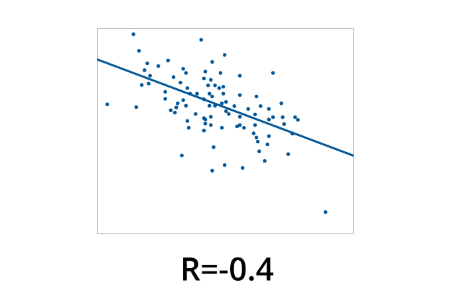
Correlation analysis, expressed by correlation coefficients, measures the degree of linear relationship between two variables.

While in regression the emphasis is on predicting one variable from the other, in correlation the emphasis is on the degree to which a linear model may describe the relationship between two variables.

The correlation coefficient may take on any value between + and - 1. The sign of the correlation coefficient (+, -) defines the direction of the relationship, either positive or negative. A positive correlation coefficient means that as the value of one variable increases, the value of the other variable increases; as one decreases the other decreases. A negative correlation coefficient indicates that as one variable increases, the other decreases, and vice-versa.

The absolute value of the correlation coefficient measures the strength of the relationship. A correlation coefficient of r=0.50 indicates a stronger degree of linear relationship than one of r=0.40. Thus a correlation coefficient of zero (r=0.0) indicates the absence of a linear relationship and correlation coefficients of r=+1.0 and r=-1.0 indicate a perfect linear relationship.

The scatter plots presented below perhaps best illustrate how the correlation coefficient changes as the linear relationship between the two variables is altered. When r=0.0 the points scatter widely about the plot, the majority fall roughly in the shape of a circle. As the linear relationship increases, the circle becomes more and more elliptical in shape until the limiting case is reached (r=1.00 or r=-1.00) and all the points fall on a straight line.

A number of scatter plots and their associated correlation coefficients are presented below:

r = 0.54

r = 1.00

r = - 0.54

image image image

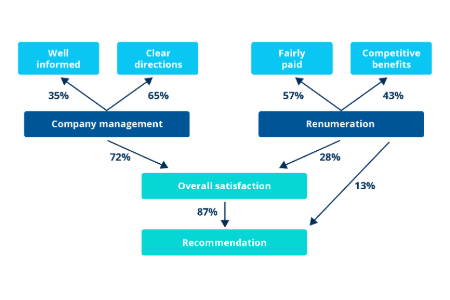
Correlation analysis is typically used for Customer Satisfaction & Employee Satisfaction studies to answer questions such as "which elements contribute most to someone's overall satisfaction or loyalty?" This can lead to a "derived importance versus satisfaction" map. See below.

It is also ideal when sample sizes are too low (e.g. less than 100) to run a regression analysis.

image

back to top

REGRESSION ANALYSIS

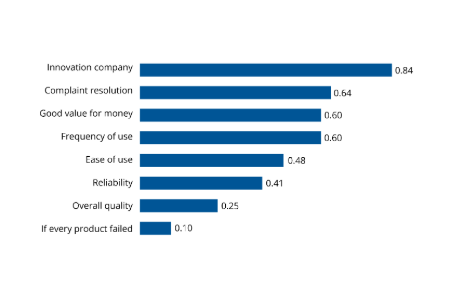
Regression analysis measures the strength of a relationship between a variable you try to explain (e.g. overall customer satisfaction) and one or more explaining variables (e.g. satisfaction with product quality and price).

While correlation provides a single numeric summary of a relation (called the correlation coefficient), regression analysis results in a "prediction" equation. The equation describes the relation between the variables. If the relationship is strong (expressed by the Rsquare value), it can be used to predict values of one variable given the other variables have known values e.g. how will the overall satisfaction score change if satisfaction with product quality goes up from 6 to 7?

image

Regression analysis is typically used:

(i)

for Customer Satisfaction & Employee Satisfaction studies to answer questions such as "which product dimensions contribute most to someone's overall satisfaction or loyalty to the brand?". This is often referred to as Key Drivers Analysis.

(ii)

to simulate the outcome when actions are taken. e.g. what will happen to the satisfaction score when product availability is improved?

image

back to top

FACTOR ANALYSIS

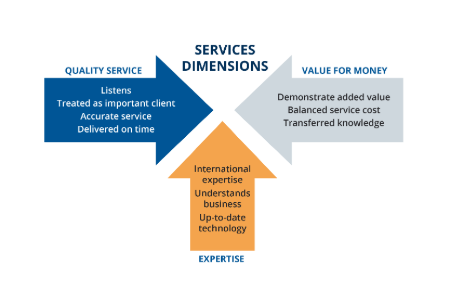
Factor analysis aims to describe a large number of variables or questions by only using a reduced set of underlying variables, called factors. It explains a pattern of similarity between observed variables. Questions which belong to one factor are highly correlated with each other. Unlike cluster analysis, which classifies respondents, factor analysis groups variables.

There are two types of factor analysis: exploratory and confirmatory. Exploratory factor analysis is driven by the data, i.e. the data determines the factors. Confirmatory factor analysis, used in structural equation modelling, tests and confirms hypotheses.

Factor analysis is often used in customer satisfaction studies to identify underlying service dimensions, and in profiling studies to determine core attitudes. For example, as part of a national survey on political opinions, respondents may answer three separate questions regarding environmental policy, reflecting issues at the local, regional and national level. Factor analysis can be used to establish whether the three measures do, in fact, measure the same thing.

It is can also prove to be useful when a lengthy questionnaire needs to be shortened, but still retain key questions. Factor analysis will indicate which questions can be omitted without losing too much information.

image

back to top

CLUSTER ANALYSIS

Cluster analysis is an exploratory tool designed to reveal natural groupings within a large group of observations. Cluster analysis segments the survey sample, i.e. respondents or companies, into a small number of groups.

Respondents whose answers are very similar should fall into the same clusters while respondents with very different answers should be in a different cluster. Ideally, the cases in each group should have a very similar profile towards specific characteristics (e.g. attitudinal or behavioural questions), while the profiles of respondents belonging to different clusters should very dissimilar.

Its main advantage is that it can suggest, based on complex input, groupings that would not otherwise be apparent ie the needs of specific groupings or segments in the market.

image

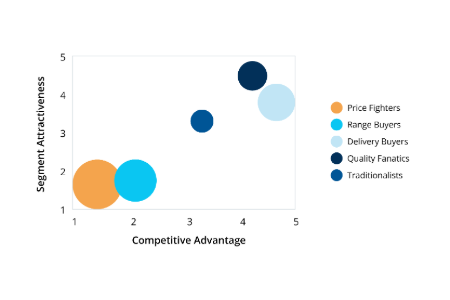
Cluster analysis is widely used in market research to describe and quantify customer segments. This enables marketers to target customers tailored to their needs instead of having one general marketing approach - see market segmentation.

Cluster Analysis

back to top

BRAND MAPPING (CORRESPONDENCE ANALYSIS)

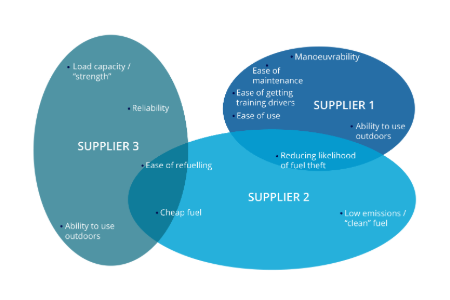
Correspondence analysis is a technique which allows rows and columns of a data matrix, e.g. average satisfaction scores for several products, to be displayed as points in a two-dimensional space or map. It reduces a complicated set of data to a graphical display which is immediately and easily interpretable. Brand maps are based on correspondence analysis.

Brand maps are often used to illustrate customers' images of the market by placing products and attributes together on a map. This allows close interpretation of company perceptions with a variety of product and service attributes simultaneously.

Brands are most strongly associated with the attributes that are closest to them on the map. If products are placed close to each other, it means they have a similar image or profile in the market.

The relative association of brands with an attribute can be determined by drawing a perpendicular line from the attribute vector line (=line from the origin to the attribute point) to each of the brands. The distance between the brand and the attribute is the distance between the attribute location and where the perpendicular line crosses the attribute vector line.

The centre of the map (the cross on the map), represents the overall mean of each attribute, and is the centre around which the brands are dispersed. The more a brand tends to lie in a similar direction away from the centre as an attribute, the more a brand is associated with that attribute. This also means that brands and attributes near the centre of the maps are not differentiating. The length of an attribute vector represents the extent to which the brands differ on that attribute.

Angles between the vectors represent correlations between attributes. The smaller the angles, the more correlated the attributes are.

An example of a brand map

back to top

CONJOINT ANALYSIS

Market research is frequently concerned about finding out which aspects of a product or service are most important to companies. The ideal product or service, of course, would have all the best characteristics, but realistically, trade-offs have to be made. The product with the most expensive features, for example, cannot have the lowest price.

Conjoint analysis is a technique for measuring respondent preferences about the attributes of a product or service. It is the ideal tool for new/improved product development. The conjoint analysis task asks the respondents to make choices in the same fashion as consumers normally do, by trading off features one against the other, either by ranking or choosing one of several product combinations. e.g. a task could be: do you prefer a "flight that is cramped, costs £250 and has one stop" or a "flight that is spacious, costs £500 and is direct"?

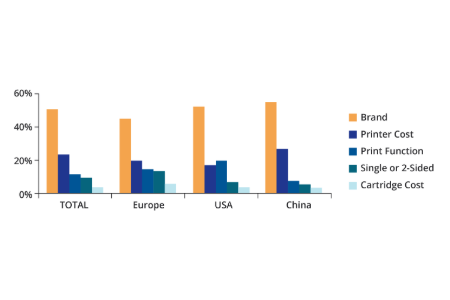
Using conjoint analysis, you can determine both the relative importance of each attribute (e.g. spaciousness, price, number of stops) as well as which levels of each attribute are most preferred (e.g. how much is a price of £250 more preferred than a price of £500).

Example: Importance Of Printer Features, Plus Simulator

Importance Of Printer Features, Plus Simulator

Importance Of Printer Features, Plus Simulator

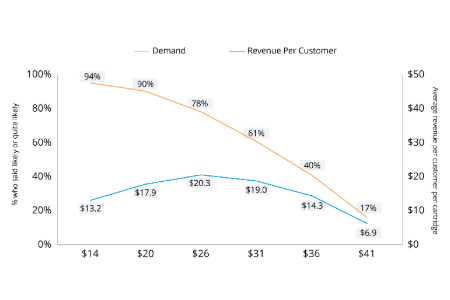
Conjoint analysis is typically used to guide new product developers by indicating which product aspects are most important to different companies. It is also useful to gauge market reaction when a product (attribute) will change e.g. what will happen to the market share of brand A if its price increases by 10%?

back to top

CHAID ANALYSIS

CHAID (Chi Squared Automatic Interaction Detection) is used to build a predictive model, based on a classification system. The analysis subdivides the sample into a series of subgroups that 1) share similar characteristics towards a specific response variable and that 2) maximises our ability to predict the values of the response variable.

The first predictor category (on which the sample will be split) is the predictor that is associated the most with the response variable. i.e. it gives the most differentiating groups of respondents. Each group is then further split until the analysis does not find any significantly discriminating predictor any more.

The predictors can be scaled (e.g. 1 to 10 scale rating) as well as categorical questions (e.g. company demographics).

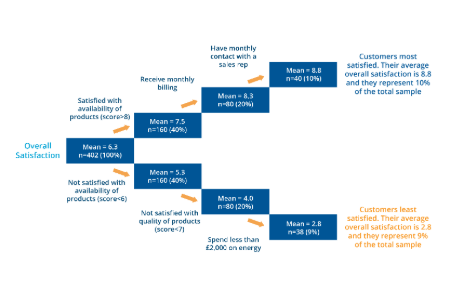
The output is a tree of which the branches are the predictor variables that split the sample in discriminating groups.

a tree of which the branches are the predictor variables that split the sample in discriminating groups

CHAID is very often used to understand the characteristics of the most and least satisfied or interested customers/employees. It allows the client to target its (potential) clients more efficiently and successfully. CHAID analysis is typically used in the direct marketing industry to identify the type of people who have reacted to a specific campaign.

back to top

DISCRIMINANT/LOGISTIC REGRESSION ANALYSIS

Discriminant and logistic regression analysis are statistical techniques that point out the differences between two or more groups based on several characteristics (most often rating scales when discriminant analysis, while logistic regression can handle any type of variable).

It explains why respondents belong to a certain group, plus it classifies new respondents based on their ratings. e.g. why are people very satisfied (i.e. gave a score 9 or 10 on a 1-10 point scale) with a product versus the rest of the market?

Is often used

  • to determine which customers are likely to buy a company's product
  • to decide whether a bank should offer a loan to a new company or
  • to identify patients which may be at high risk for medical problems

Aspect impacting on whether someone will buy a product

back to top

MULTIDIMENSIONAL SCALING

Multidimensional scaling (MDS) can be considered to be an alternative to factor analysis. In general, the goal of the analysis is to detect meaningful underlying dimensions that allow the researcher to explain observed similarities or dissimilarities between the investigated objects. In factor analysis, the similarities between objects (e.g. variables) are expressed in the correlation matrix. With MDS one may analyse any kind of similarity or dissimilarity matrix, in addition to correlation matrices.

This outcome is visualised in a 2 dimensional map, which gives the researcher an immediate feel of how differentiating the questions were. Questions which are clustered together did get very similar scores by all respondents. This can be very useful when optimising a questionnaire or to differentiate consumers based on the most distinct questions.

Even though there are similarities in the type of research questions to which MDS and factor analysis can be applied, they are fundamentally different methods. Factor analysis requires that the underlying data is distributed as multivariate normal, and that the relationships are linear. MDS imposes no such restrictions. Just as long as the rank-ordering similarities in the matrix are meaningful, MDS can be used.

In terms of resultant differences, factor analysis tends to extract more factors (dimensions) than MDS; as a result, MDS often yields more readily, interpretable solutions. Most importantly, however, MDS can be applied to any kind of similarities, while factor analysis requires us to first compute a correlation matrix. MDS can be based on subjects' direct assessment of similarities between stimuli, while factor analysis requires subjects to rate those stimuli on some list of attributes (for which the factor analysis is performed).

In summary, MDS methods are applicable to a wide variety of research designs.

MDS methods are applicable to a wide variety of research designs

back to top

STRUCTURAL EQUATION MODELING

Structural Equation Modeling (SEM) is a very general, very powerful multivariate analysis technique that includes a number of other traditional analysis methods as special cases. It effectively includes a whole range of standard multivariate analysis methods, such as regression, factor analysis and analysis of variance. A structural equation model can exist with several regression and factor analysis models, which are estimated simultaneously.

It is a statistical methodology that takes a hypothesis-testing (i.e. confirmatory) approach to the multivariate analysis. SEM tests a theory using survey data, while traditional modeling uses the data to build a model (i.e. exploratory approach).

Commonly used for validating models, e.g. a CRM model using survey.

a CRM model using survey

back to top

Blank
Market Research With Intelligence
BlankB2B International in the UK B2B International in the UK B2B International in the USA B2B International in Europe |  B2B International in China 
Beijing, China   Moscow, Russia   London, UK   New York, US   Blank September 02, 2010
Blank