


For many years, pricing research in B2B markets was relatively straightforward. A product was defined, buyers were asked what they would be willing to pay, and established methodologies helped identify an acceptable pricing range. The challenge was largely about finding the optimal price point.
Ever since subscription-based business models entered the mainstream, that world has changed.
Increasingly, organizations are no longer pricing a single product or service. They are pricing subscription models, bundled solutions, usage-based contracts, tiered offerings, implementation fees, support packages and long-term partnerships. At the same time, buying decisions are being made by larger and more diverse groups of stakeholders, each bringing their own priorities, expectations and perceptions of value.
For marketers, product teams and insights professionals, this shift creates an important challenge. Pricing decisions no longer influence revenue alone. They affect positioning, customer acquisition, competitive differentiation and how value is perceived in the market.
The future of pricing research is not simply about determining what customers are willing to pay. It is about understanding how value is perceived across a complex buying ecosystem and identifying the pricing strategy that can maximize both growth and profitability.
Modern Buying Groups Have Changed the Pricing Challenge
One of the biggest challenges facing B2B organizations today is the increasing complexity of the decision-making unit. In many markets, a purchase decision is no longer driven by a single buyer. Technical users, operational stakeholders, procurement teams, finance departments and senior decision-makers may all play a role in evaluating a solution.
Each of these stakeholders often has a different perspective on value. The technical team may focus on performance and functionality. Procurement may be tasked with reducing costs. Senior leaders may be evaluating strategic impact and long-term return on investment.
From a pricing perspective, this creates a significant challenge. A price that feels justified to one stakeholder may appear excessive to another.
Understanding these differences is increasingly important, not just for pricing decisions but also for positioning and messaging. The same research that explains willingness to pay can often reveal which value propositions resonate most strongly with different stakeholders and where barriers to purchase exist.
Pricing research therefore needs to move beyond measuring willingness to pay at an overall market level. It must uncover how different stakeholder groups perceive value and how these perceptions influence commercial outcomes.

The Shift to More Complex Commercial Models
The products and services themselves are becoming more complex too. Traditional pricing studies were often designed around a single transaction. However, many B2B offerings now include multiple pricing components. Customers may pay an implementation fee, a recurring subscription charge, usage-based costs and optional add-ons, all within the same commercial model.
Consider a SaaS provider moving from perpetual licenses to subscription pricing, or an industrial manufacturer bundling digital services into a traditional product offering. In both cases, the challenge is not simply determining the right price. It is understanding which commercial model customers find most compelling, acceptable and easy to justify internally.
This complexity means that simple pricing approaches are often no longer sufficient. Businesses need to understand how customers evaluate different pricing structures and which combinations of features, services and price points create the strongest value proposition.
As a result, advanced methodologies such as conjoint analysis are becoming increasingly important. These approaches allow organizations to test multiple pricing and product configurations simultaneously, helping them understand the trade-offs buyers are willing to make and the likely impact of different pricing strategies in real-world market conditions.

Pricing Cannot Be Separated From Competitive Strategy
Another major shift is the growing importance of competitive dynamics.
In some markets, pricing decisions are driven primarily by customer value. In others, competitor behavior can have an equally significant influence.
Organizations frequently face difficult choices between protecting margins and pursuing market share. A small price change from a competitor can alter customer perceptions, reshape buying behavior and affect revenue forecasts.
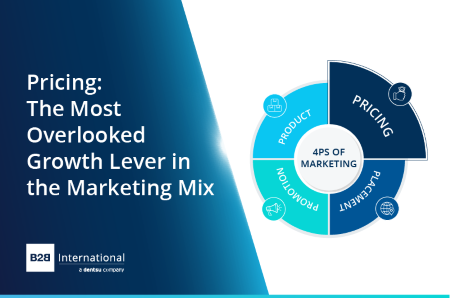
For business leaders, this highlights a broader reality: pricing is one of the most powerful strategic levers available to an organization. It influences not only profitability but also market positioning and perceptions of value.
This means pricing research can no longer focus solely on customer preferences in isolation. Businesses need to understand how the market may respond to different pricing scenarios and how competitors could react to changes in pricing strategy.
The most effective pricing studies increasingly incorporate scenario modelling, allowing organizations to explore different competitive outcomes before making commercial decisions. Rather than asking what price customers would pay today, businesses are increasingly asking how pricing decisions will perform in a dynamic market environment over time.

AI Will Make Pricing Research Smarter, Not Obsolete
With the rapid growth of artificial intelligence, it is natural to ask whether AI will eventually replace traditional pricing research.
AI undoubtedly has an important role to play. It can help analyze large datasets, identify patterns and support forecasting activities. However, when it comes to understanding value perception, particularly for innovative products or entirely new categories, there remains a critical need for direct customer insight.
The reality is that pricing decisions are rarely driven by logic alone. Brand reputation, trust, perceived risk, previous experiences and emotional factors all influence purchasing behavior. These are areas where human feedback remains essential.
When organizations are introducing something genuinely new to the market, there is often little historical data available. In these situations, the most reliable source of insight remains the customer themselves.
The future of pricing research will therefore not be defined by AI replacing research. Instead, it will be defined by combining advanced analytical techniques with robust customer understanding to create more accurate and actionable pricing strategies.

Why Pricing Research Is Becoming a Strategic Business Discipline
For many organizations, pricing research has traditionally been viewed as a tactical exercise conducted at a specific point in time.
That view is becoming increasingly outdated.
As pricing models become more sophisticated and buying processes become more complex, pricing research is evolving into a strategic capability that helps organizations make better decisions about growth, positioning, customer value and competitive advantage.
The organizations that succeed will be those that recognize pricing decisions should be informed by external evidence rather than internal assumptions. The cost of getting pricing wrong can extend far beyond revenue, influencing customer acquisition, retention, market perception and long-term profitability.
Turning Pricing Complexity Into Competitive Advantage
At B2B International, we help organizations navigate this complexity. Whether launching an innovative solution, reviewing an existing pricing strategy or optimizing a complex commercial model, our pricing specialists combine advanced methodologies with deep B2B expertise to deliver evidence-based recommendations that drive growth.
What makes pricing research particularly valuable today is that it rarely answers just one question. Done well, it can uncover how customers define value, how buying groups make decisions, which propositions resonate most strongly and how organizations can strengthen their competitive position.
As pricing models continue to evolve, the organizations best positioned for success will be those that develop a deeper understanding of customer value and use that understanding to make informed commercial decisions.
The future of pricing research is undoubtedly more sophisticated than ever before. But for organizations willing to embrace that complexity, it also presents one of the greatest opportunities to drive sustainable growth and competitive advantage.
Readers of this article also viewed:
Pricing: The Most Overlooked Growth Lever in the Marketing Mix What It Really Takes to Achieve Premium Positioning in B2B 3 B2B Pricing Challenges and How to Overcome Them Introducing the RIVR Pricing Model The Value Equivalence Framework: A Simple but Powerful Questioning Technique What It Really Takes to Achieve Premium Positioning in B2B What Is Conjoint Analysis? What Is Brand Price Trade-Off (BPTO)? What Is the Van Westendorp Pricing Model? What Is the Gabor Granger Pricing Model?
To discuss how our tailored insights programs can help solve your specific business challenges, get in touch and one of the team will be happy to help.