

According to Nielsen, companies spend close to $600 billion per year on advertising. This includes expenditure on TV, newspaper, magazine, radio, outdoor and internet display advertising. It does not, however, include expenditure on sponsorship. Sponsorship is estimated to amount to just over $50 billion per annum. Global advertising continues to grow at around 3% per annum and sponsorship is growing at 4% per annum. There must be something in sponsorship to justify this huge and growing investment.
Testing the effectiveness of advertising using market research is a process that has been refined over the years. Using both ad testing market research and advertising effectiveness research, we can test an ad before it is launched, and we can carry out pre- and post-advertising research to determine whether specific campaigns are effective. However, testing the effectiveness of sponsorship is more difficult since it may be a simple matter of a brand name emblazoned on a shirt, or a car, or on the side of a sports ground. Sponsorship can be expected to build up the awareness of a brand and influence the perceptions of the brand through association with the sport. This is more tenuous than the effect of an ad campaign and, not unreasonably, sponsors are eager to know what return they are getting on their investment.
The decision to invest in sponsorship is usually taken at the highest level within a company. Whereas ad campaigns are managed by professional marketing and communication teams in a company, the decision to sponsor, for example, an event at Ascot, a musical programme at the Royal Albert Hall or a cycling team in the Tour de France, will very much depend on the predilections of the chairman or the CEO of a company. CEOs who are fanatical about soccer are more likely to endorse a sponsorship program of a football club than CEOs whose outside work interests are focused on fine art. This bias in investing in sports or events is a potential nightmare for the marketing and communications teams as it may mean that a sponsorship programme is entered into which is wholly inappropriate for a company.
This raises an important point about sports sponsorship and its ROI. Let’s take an example of a chairman who chooses to sponsor an event at Glyndebourne because he is interested in opera. Let’s also assume that the chairman and directors use this event to entertain a number of strategically important clients who so appreciate the invitation that they increase their spend and loyalty with the company. On these grounds alone the sponsorship may be more than justified. This sponsorship was not intended to build broad awareness: it was intended to ingratiate a small number of key clients and it did so with great success.
Our interest in sponsorship research in this discussion paper goes beyond measuring the justification of personal indulgences of chairmen. It is about much larger investments – for example, measuring the effectiveness of the huge sums of money that are put behind a football club or a tennis star, or which support a Formula One team.
One reason that sports or event sponsorship is so popular is because people who support a sport or event are extremely passionate it. These fans (i.e. fanatics) are loyal, passionate and committed to the sport itself and, in particular, a team or hero that they support. This passion is what makes sports sponsorship research different from advertising research. People reading, seeing or hearing an ad for a product may be given an emotional tingle but they are also given logical reasons as to why the product or service is right for them. In sports sponsorship there is little logical argument, and reliance is placed on the strong emotional link with the sport itself.
This brings us to the subject of “fit”, which is crucially important in sports sponsorship. Sponsorship is likely to be much more effective if a brand that is emblazoned on a shirt fits with what the sponsoring company does and what it stands for. It could be argued, for example, that it makes sense for a postal delivery company to sponsor Formula One racing because it seeks to build a reputation for speed, power and innovation. All these qualities can be transferred from the associations people have with the racing circuit. In a similar vein, it does not make sense for a children’s nursery to sponsor a boxing event. The fit of a brand must also extend to the fit with the target audience of the sport or event. It is no surprise, therefore, that private banks spend money sponsoring cultural events in the belief that wealthy people (their target audience) are often elderly and with a high interest in culture.
In making the link between a brand and a sport, we must pay attention to “attribution theory”. This theory links the relationships we have with other people and ourselves. Professor Fritz Heider, in the middle of the last century, developed an attribution theory which argued that our psychological balance is changed depending on who is involved in the relationship. Take, for example, the relationship you have with a friend; this could be changed if you invite another friend to join you on a date. This interrelationship between people can be extended into sports sponsorship where an individual, the club they support and a brand become intertwined.
Heider’s Theory of Attribution
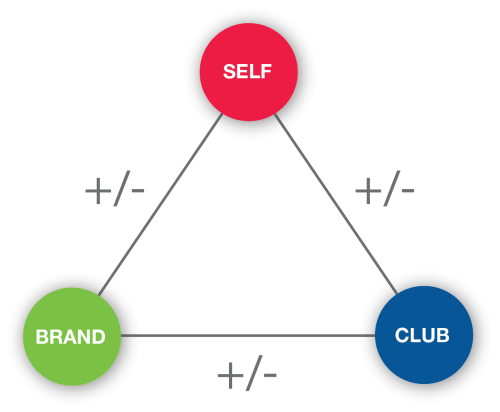
I live in Manchester and inevitably have an interest in the football clubs that have played a role in making this British city famous. Aeroflot recently entered into a sponsorship deal to become the Official Carrier of Manchester United Football Club. How did this influence my attitude to Aeroflot and how did this influence my attitude to Man Utd? Did my estimation of Aeroflot go up because of its association with the prestigious club and did my estimation of Manchester United go down as I was confused as to why it had accepted sponsorship from an airline that isn’t particularly well known for high levels of service? A market research study aimed at determining the effect of sponsorship should attempt to measure the interrelationships between the different parties and the way they are affected over time.
There are proprietary research tools that can be used to measure the effectiveness of sports sponsorship. If the sport has a wide following it may be appropriate to track positive and negative sentiment expressed in social media and to see how this changes over time. It may also be possible to run measures which capture the amount of time that a sponsor’s name is visible during a football match and the numbers of people who have watched the match both live and on television. This gives some indication of the “opportunities to view” the brand even though it doesn’t tell us to what extent the brand has sunk in.
For this we have to turn to conventional market research such as measuring the proportion of people who claim to be fans of a sport and how many of these recall (both unprompted and prompted) the brand of a sponsor. Since much of this recall is subliminal, it is a crude measure of effectiveness. It may therefore be worthwhile focusing on diehard fans of a sport to see whether their passion has in any way been transferred to the sponsoring brand. This could be tested in simple word association questions and also “likelihood to buy” questions.
And finally, we shouldn’t forget where we started in this discussion, which is the use of sponsorship for strategic entertainment. If the sponsorship is thought to have a strong positive impact on employees or key customers who have been entertained at specific events, research should be carried out with these audiences to see what impact it has had. The sponsorship may be fully justified amongst this quite small target audience alone.