Left Bar
Box B2B International - Business-to-Business Market Research The Market Research Blog
Blank
Blank
Blank
Blank

Archive for the ‘Pricing Strategy’ Category

« Previous Entries  

What Can Marketers Learn From English Seduction Techniques?

Friday, March 12th, 2010

This week Director Matthew Harrison draws the key marketing lessons from his (now dormant) seduction techniques.

Each and every year, the month of March is a joyous occasion for me. The brutal New York winter dissipates and makes way for 8 months of glorious sun. The English football season reaches its climax, as along with the rest of the Western world I fix my attention on Nottingham Forest’s promotion challenge. Most importantly and joyously of all, the month of March marks the anniversary of my wedding, which I should highlight (just in case she’s reading) was a day of unparalleled perfection.

And so this week my mind took a surreptitious walk down memory lane to a warm September day in 1997, a lucky 13 years ago. This was the day when I targeted my now-wife and (eventually) convinced her that I would fulfil her every need. Now, as a marketer first and lady-magnet second, thoughts of this distant time got me thinking. What, if anything, could my seductive exploits of the late 90s teach me and the wider marketing community about appealing to their target audiences? If I can successfully target that most notoriously demanding of audiences, the attractive female, surely there is no limit to my marketing prowess?

That sunny day in 1997 had been an inauspicious one, at least from a professional point of view. My finest achievement had been to break the photocopier and spend 90 minutes failing to fix it. As I returned home at 5.30, I frankly needed a beer. I delicately broached the subject with my housemate Dave, who pondered my request before suggesting we go to the pub immediately.

Two hours and 5 pints of Kronenbourg later Dave and I were deep in discussion, our agile minds flitting between the meaning of life and whose turn it was to buy the next drink. I was just about to walk towards the bar when I noticed the door open and two girls in their early twenties walked in. I salivated, ordered another round and began plotting my next move. My mission: to make the blurred, dark-haired girl on the right fall in love with a drunken photocopier-wrecker. Mercifully, Dave told me a joke about Camilla Parker-Bowles, distracting me for the rest of the evening.

Several evenings later, a group of friends and I decided to meet up in the same bar. Word was that a selection of females would be present, some of whom would be more than happy to meet the man of their dreams this evening. Even better, one or two discrete enquiries amongst the local cognoscenti revealed that the blurred girl was called Caroline and would be making an appearance along with her friends.

I sensed my chance, and quickly set about polishing my shoes, getting Dave to iron my shirt, and splashing myself in enough Fahrenheit to make a cactus wilt. I donned my leather jacket and, fusing debonair cool with rugged Anglo-Saxon masculinity, unbuttoned the top 2 buttons of my shirt. It would be no exaggeration to say that I looked irresistible.

Scanning the bar as I arrived mid-way through the evening, I immediately saw Caroline, chatting with her friends in the far corner. She was tall and slender with long, dark brown hair. Her dark knee-length skirt and tailored jacket clung enticingly to her figure and her top revealed a hint of décolletage. Her outfit reminded me of the perfect hors d’oeuvre: just enough to keep the interest; not quite enough to make me feel queasy and rush for the exit. I wonder if anyone’s ever delivered a finer compliment than that to her? I do hope so.

Rather than striding confidently towards her and delivering a killer chat-up line in front of her friends, I bravely decided to wait until she was on her own and then pounce. This must have been my lucky day because a few minutes later I found myself standing next to her at the bar.

We started talking. Now when I talk to attractive ladies, I have something of a magic touch – I start talking and they immediately disappear. Strangely, however, for an apparently sane woman with all of her faculties intact, Caroline responded – and not with a restraining order. She laughed at my jokes. She nodded as I told her all about my big-shot job in the photocopying room. She gasped with relief as I finally asked her a question. She seemed to believe me when I said that it must be the man behind me that stank of vinegar.

We met up a few more times over the following week or two, each encounter becoming slightly more relaxed than the last. I took her to a restaurant and tried to show off by buying some expensive wine that I’d never heard of. We went to a football match with a group of friends. Gentlemen, I hope you are learning as you read this. After 4 or 5 ‘meetings’ we were officially an item and I was congratulating myself on my marketing expertise.

So, when I look back at the seductive marketing techniques I employed in my early 20s and reflect upon how they changed the course of my life, I am struck by how similar the art of attracting a business-to-business customer is to the seduction of a beautiful woman. I therefore leave you with my key tips on how to attract and keep the most demanding of b2b customers:

Make the first impression count – A sober, well prepared marketing approach is always likely to be more effective than an impulsive dash in the direction of the target customer. This applies to all aspects of the marketing mix, from promotional materials and interpersonal contact through to pricing and proposal preparation. By the time you get to undoing an early bad impression, the object of your desire will already be looking elsewhere.

Expect the sales process to take 4 or 5 contacts – Business-to-business buyers, like women, are complex creatures. The quick ‘hard sell’ is far less suited to their multifaceted needs and their focus on interpersonal contact than it is to the more impulsive and impersonal world of consumer marketing. It is critical to take the time over a number of conversations to understand customers’ rational and emotional needs, before providing a personalized solution built around these.

Ask lots of (intelligent) questions – Like the most boring of inebriated men, bad b2b marketers focus so much on their own offering that they forget to ask the target customer what makes them tick and what would make their lives better. This is a fatal mistake when each target customer has needs that are often technical, complex and unique.

Always leave them wanting to find out more – Successful business-to-business marketing is a long-term, dynamic process built around frequent conversation and mutual exploration. The effective b2b marketer answers every question concisely, whilst hinting at new, intriguing ideas that make the target customer want to find out more next time.

Tell a coherent, authentic story and stick to it – This is the most difficult and most critical trick of all. Just as the single man identifies an overall impression he wants to project to the fairer sex and attempts to dress, smell and speak in a way that authenticates that impression, so the successful b2b marketer must identify the story that target segment wants to hear and ensure that every customer touchpoint authenticates that story. This requires consistency, and – most fundamentally – a deep and accurate understanding of what the target market wants from you. Master these two basics and you are on your way to becoming a seductive b2b marketer.


Market Research: The Second Oldest Profession?

Friday, September 4th, 2009

Paul Hague this week takes us on a trip down memory lane to discover the origins, history and development of the market research profession as we now know it.

A prostitute, a doctor and a market researcher were sitting around late one evening, and they got to discussing which was the oldest profession.  The doctor pointed out that according to biblical tradition, God created Eve from Adam’s rib. This obviously required surgery, so therefore that was the oldest profession in the world.  The prostitute said that this may be so but that was engineered by God, not doctors.  Eve’s temptation of Adam was a clear indication that her profession was the first.  The two turned to the researcher who was listening intently and taking notes.  "Which profession do you think is the oldest?" they asked. "Well," said the researcher, "we can’t be sure without a survey and that will take six weeks.  However, what you should know is that market research is the second oldest profession."  "How is that?" asked the other two in unison.  "No doubt at all about it," said the researcher, "because when Adam and Eve had done their deed, the first words that were uttered were, "How was it for you?"".

This story got me thinking about the history of market research.  Casual questioning, as from Eve, is not the systematic process that we know as market research.  It is said that the first recorded straw polls (incidentally, the term comes from farmers throwing a handful of straw into the air to check out where the wind was coming from) were in the early 1820s when newspapers in the United States carried out simple street surveys to see how the political winds were blowing.  By the early 1900s a fledgling market research industry had started in the U.S. focusing on advertising testing in one form or another.  The industry arrived on the U.K. shores in the 1920s and 30s, and I was reminded of this the other day when I picked up what must be one of the first books published on market research in this country (Market Research by Paul Redmayne & Hugh Weeks, Butterworth & Co – 1931).

Flipping the yellowing, musty pages, I was quickly taken back to my formative days in the market research department of Dunlop, where we had an ingenious device for analysing responses from questionnaires.  The closed answers were represented on single cards, perforated with holes around the edge, each representing an answer to a question.  If a respondent gave a particular answer, the perforated hole would be punched open right to the edge.  When all the cards were punched, they could be lined up in the box and a needle would be run through the holes so that we could lift out only those cards which were not punched right to the edge.  This enabled us to do a quick count of the number of cards left in the box, which represented respondents giving an answer to a question.

Charting in those days was laboriously carried out with my Rotring pen and graph paper.  Redmayne and Weeks had some sage advice for the novice market researcher on this subject: "There are many advantages in using a standard sheet of charting paper, so that charts can be kept together in a ring binder.  It is useful to make a practice, dating each chart and of indicating to whom it has been shown and for what purpose it was first prepared, together with the original source of the various statistics plotted."  Check out this illustration of how they suggested charts should look.  You wouldn’t easily turn out 100 of these by hand the night before a presentation!

Hand Drawn Chart

So what has changed in the market research industry over the last 100 years?  Answer: almost everything.

The questions we ask are broadly the same but the technology that allows us to ask these questions – the phone and online – has resulted in faster, cheaper and more thorough surveys than ever before.  Qualitative research is, as it always has been, dependent on the skills of the moderator, although focus group venues provide an improved environment for viewing and testing products and concepts.  In quantitative research, the tools and techniques such as conjoint, SIMALTO, Van Westendorp and the like enable us to get a better fix on prices and product features.  I was amused to read Redmayne and Weeks say: "As market research acquires a more established position in industry, its purpose will be better understood and appreciated by ordinary men and women, so that in time we may hope to reach the position of the United States, where the man in the street will respond to questions about his tastes and his buying habits since he can understand the reasons why he is being questioned. The time, however, is still very far off when consumers will have cause to be annoyed by the frequency with which they are approached.  It will need a great number of investigations before many of the inhabitants of this country are called upon twice unless the general technique of investigations become so stereotyped that certain representative towns are continually being chosen."  There must hardly be a person in the UK who has not been subjected to some sort of invitation to take part in a survey in the last year.

Returning to the story of the doctor, the prostitute and the market researcher, it occurs to me that market researchers may or may not be the second oldest profession in the world, but for certain, we will be the last profession hanging in there.  When the world finally comes to an end, and we are queuing at the entrance to the Pearly Gates, there will be someone with a clip board and a questionnaire.  "Just one more question Sir/Madam before you enter.  Can you tell me how likely you are to recommend life on earth on a scale from 1 to 10 where…?"  It’s that question again – "How was it for you?"


Recognising the Price Typology

Friday, August 21st, 2009

At a time when consumers and businesses alike are watching the purse strings, Carol-Ann Morgan reiterates the importance of understanding what buyers of your products and services really value.

The newspapers tell us today that the recession is subsiding, and that we are fighting back to economic recovery. Times have been hard for businesses and for individuals, and everyone has felt the need to tighten their belts. We find ourselves watching the bank balance, cutting costs, and curbing spending; frugality is in and excess is out (for now at least!). This, in turn, can impact on the pricing strategy adopted by many companies, as some consumers change behaviours of past times; buying less, buying differently, reappraising the value of their purchases. This pattern then impacts down the supply chain, affecting both B2B and B2C companies.

Price has always been a subject of much debate; how to do it, how to value products, competitive pressure, product lifecycle, buyer behaviours, customer loyalty, etc, etc. However, the key element of price is in the value of the product and/or service to the customer, and strategies have to reflect this.

Market segmentation enables companies to better serve the market, developing and marketing products which resound more closely with the intended customer base. Most needs based segmentations will reveal a price driven segment; one where, above all, the price is the major decision making driver. Interestingly, it is usually a much smaller segment than people suppose. Of course, price always has a role in decision making, and it is important to establish how and where it is positioned for our customers and potential customers.

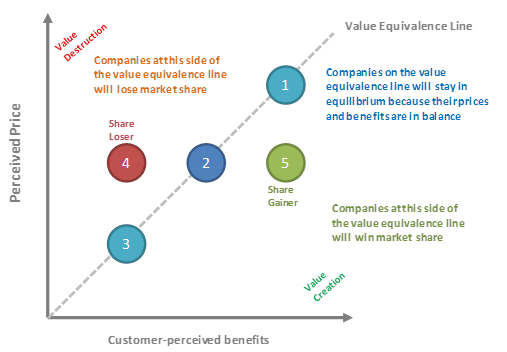
I see several typologies for price positioning, based on the relationship between price and perceived value. These four, in particular, are common and easily recognisable…

  • Cheapest Price: Firstly, price driven buyers who are simply looking for the lowest price available in the market. Nothing else matters, lowest price is king. These buyers are the absolute price segment. They are easy to spot, and they search around looking for lower and lower prices, sometimes using a competitor price as a bargaining tool. They are not concerned about brand and tend towards the view that all products are the same and the additional cost is in name only.
  • Best Price in Class: This group values certain products/services and their features. They are more choosy about what they want and may operate within a “brand division” and only place products from certain brands in their consideration set. For example, they want a premium quality boiler and will only look at products within this product value grouping. However, they will consider any of the brands in this grouping and will buy the cheapest they can get within the division. They value the product group (e.g. premium boilers) but are looking for the best possible price across the brands that fall into that group, without being hard set on one particular brand.
  • No Compromise: They know what they want (exactly!) and are usually unwilling to compromise on what they want (product, model, brand, supplier, etc). They negotiate hard to get the lowest price for this. They use other suppliers’ prices as bargaining tools but their choices are limited, usually to a specific product and a specific, (often) very well known, reputable brand they value highly, usually from recommendation, from reviews or from personal experience. They will, however, settle for a price above what they wanted to pay if they cannot get suppliers to meet their need on price, such is their desire for the particular product and brand.
  • Value Pricer: This group will be likely to balance price against the value that can be gained from a certain product and a certain supplier/brand. The value to them may be in safety, security, image reflection, performance characteristics, reputation, etc, but whatever it is, it has a value which they are prepared to pay for. The higher that value to them, the higher the price tag they are prepared to pay. It is a question of identifying where the value is. However, if the product/service fails to meet the standard, a “value gap” occurs which can cause re-evaluation of that value to them.

The question now is whether or not the global frugality has made us all more price conscious than we were previously. Thus, the way in which the price and the product are valued needs to be understood in depth in order to accurately evaluate the position of price in the mind of our target customers. This is especially the case for B2B companies where the value of an order or longer-term supply relationship can be critical to business survival.


Where is the love?

Friday, June 12th, 2009

In this week’s Thursday Night Insight, Julia Cupman draws the analogy between marketing and Cupid’s bow and arrow…

The TV series The Bachelorette is arguably complete and utter rubbish that is watched avidly by hormonal 16 year old girls and me.  I’m not ashamed to admit that I follow this reality TV show and look forward to it every Monday evening.  To me, the series is enjoyable escapism from the daily grind of complex questionnaire design, heavy-going data crunching and desk research on industrial products.

For those of you who are unfamiliar with the TV series, The Bachelorette is all about dating.  The series is based on one woman – the eponymous single – and thirty supposedly eligible men, all of whom are seeking to impress the Bachelorette, to fall in love with her and to ultimately marry her.  The challenge is to keep in the competition as every week at least one man is “dumped”, i.e. voted off the show by the very Bachelorette herself.

The Bachelorette is clearly a damsel in distress who is so desperate to settle down that she retorts to this rather pathetic TV series as a last resort.   The series producers have gone to every length to ensure that a wide demographic spread of male hunks of anatomy is represented, from blonde-haired Baywatch surfer types to brown-haired Mel Gibson look-alikes, from goody two-shoes to bad boys, from young sweethearts to mature softies.  What’s more, there’s a good mix of professions in there too including an Olympic cyclist, a break dance instructor, a pizza entrepreneur, an oil and gas consultant and a wine maker.

So ladies – do any sound appealing yet?  Probably not as this is not enough information to make one of the most important decisions of your life.  Marrying a man is almost synonymous with buying a house.  It is a huge investment to make as the life of singlehood is sacrificed for a life of sharing virtually everything – belongings, experiences, emotions etc.  And the reason I think this TV series is so ridiculous is because this very investment is made through a contrived process and in a very false setting.

You’re probably wondering where this is all going and how I see a link with marketing.  Having watched this drivel, it occurred to me that every one of us subconsciously goes through a marketing exercise in relationship building.  The TV series shows, admittedly in an over-the-top fashion, how by process of elimination, the Bachelorette makes her selection around the 4 Ps:

  1. whether the product (in this case, the man) meets her needs;
  2. whether the product is in the right place (an Alaskan may be a turn-off to this Canadian Bachelorette who is used to the buzzing city of Vancouver);
  3. whether the promotion resonates (e.g. if the product is attracting interest through effective communications);
  4. and for all of this, whether the price is right (in the case of the Bachelorette, what she needs to give in order to get what she wants).

Successful marketing is like true love.  Like true love, marketing has to be requited in that a company has to make its products engaging for its users to become engaged.  The recent recessionary storm with decreased expenditure on marketing has taken the spark out of so many business relationships, leaving many fickle buyers who are no longer loyal to the products they used to love.

Companies whose prospects are yet to be found or whose customers are no longer loyal should boost their marketing testosterone to establish or reignite the chemistry between their products and users.  So much in life is about creating and maintaining successful relationships.  Marketers need to ensure that their offering has that wow factor in order to strike while the iron is hot!


What Can Marketers Learn From Extravagant MPs?

Friday, May 29th, 2009

In his latest Thursday Night Insight, Matthew Harrison reflects on what lessons we can take from the latest scandal that’s plastered across all the British newspapers.

Despite working in the US, I do like to keep in touch with events in England – my home country – on at least a weekly basis.  Most weekends I will spend an hour or two on the Internet looking through the newspapers and marvelling at the content.  I read a couple of weeks ago how sun-soaked Britain – at a balmy 62 degrees Fahrenheit – would be ‘warmer than Tel Aviv’ later that week.  I was informed a week later that Neanderthal men – rather than being wiped out by disease or developing over time into human beings – were in fact eaten by the French.  And only yesterday I learned that a 73-year-old pensioner who performed a daring break-dance routine on Britain’s Got Talent has been claiming for disability benefit.

Whilst the ludicrous content of these stories provided the reader with plenty of entertainment, their impact pales into insignificance against what is regarded to be the ‘biggest political scandal in decades’, namely the Daily Telegraph’s exposure of British politicians’ expense claims.  The details of these expense claims have caused widespread offence and outrage at a time of economic hardship for the country.  Some of the claims, it has to be said, were jaw-dropping, including an ornamental floating duck house (£2,000), moat-cleaning at a politician’s sumptuous country mansion (another £2,000), 2 pornographic films (£12), multiple toilet seat replacements and a £1,800 limousine ride to a football match.  Other politicians have used public money to furnish their family homes or indulge in tax-free property speculation.

As I laugh and wince at the tales of extravagance and anger currently filling the UK newspapers, it seems to me that marketers can learn a number of things:

The importance of (authentic) story-telling

Successful marketers depend on telling an appealing story that can be defended as authentic.  When a story is exposed as unauthentic, trust in the supplier evaporates, and the costs in terms of damage to reputation and lack of repeat sales usually far outweigh any sales made through ‘mis-selling’.  The double-glazing salesman who sells the promise of a warm, dry home will not stay in business long if his windows let in the wind, rain and next door’s dog.   The same goes for the restaurant that promises Michelin Star standard food that turns out to taste like a Dunlop tennis shoe.  MPs, who ‘sell’ amongst other things financial responsibility and moral leadership when they are elected, kill their hopes of ever ‘selling’ their candidacy to the public again when they are exposed as frauds.

The importance of transparent pricing

At B2B International, we are frequently faced with questions such as the following:

  • When we enter a new market, should we price low in order to gain market share (penetration pricing) before increasing prices over time?  Or should we begin as we mean to go on, with high prices to reflect a high quality offering (premium pricing)?
  • Should we offer an all-inclusive price, providing the customer with simplicity, or should we allow the customer to spend as much or as little as he/she wants, by providing a series of pricing options?
  • How should we price to different segments?

The answers to these questions vary hugely according to the market we are studying, the client we are working for, and a host of other factors.  However, there is one factor that is universal to all of the pricing work that we do: Above all, customers want to know how much they are paying, and what they are paying for.  In other words, they want transparency.

A key reason for the negative public reaction to the politicians is not the total price taxpayers are paying for the politicians; rather it is that they are paying 20% or so more than they were told.  People feel betrayed by this unexpected price supplement, just as they would with a product or service that did not meet their expectations.

In business, also, a breach of trust can be fatal.  I was recently furious when my bank charged me $15 for a new check-book.  Not because $15 is a lot of money, not even because I don’t think my bank should charge me for allowing me to spend my own money.  I was furious because the bank had consistently told me that my account was free and never mentioned that there would be a charge for new check-books.    I felt cheated, and my trust in the bank evaporated to such an extent that I have now opened an account with a different bank.

Problem-solving can turn a negative into a positive

A constant feature of the customer satisfaction studies carried out by B2B International is that satisfaction tends to be driven not by the product per se, but by the extended offer – the services that surround the product.  This often means that a company can gain market share not by increasing product quality (so long as quality meets a certain minimum standard) but rather by responding efficiently and effectively when quality problems do occur.  Whilst a number of MPs have sealed their own fates by blaming their extravagances on the rules they were working to or denying that they have done anything wrong, others have defended or even improved their reputations by apologising profusely and promising to reform the flawed expenses system.

Indeed, just as many of our clients in industries as diverse as telecoms, education and industrial equipment have provoked significant increases in client satisfaction not through product innovation, but rather through improved aftersales and problem resolution, perhaps there can be a happy ending to the long-running expenses story.


« Previous Entries
Blank
Market Research With Intelligence
BlankB2B International in the UK B2B International in the UK B2B International in the USA B2B International in Europe |  B2B International in China 
Beijing, China   Moscow, Russia   London, UK   New York, US   Blank March 16, 2010
Blank