Archive for the ‘Net Value Score’ Category


Love Of Loyalty

Tuesday, October 16th, 2012


Post to Twitter Post to Facebook Post to LinkedIn

Helping to create a strong company brand is something B2B International helps our clients strive for on a daily basis. By understanding a customers journey and satisfaction levels at each stage helps improve a Net Promoter Score (NPS).

The higher an NPS score the greater the number of Brand advocates. These advocates have a benefit on revenue as they are 50% more likely to create a contact that influences a purchase.

The info-graphic from Customer Advocacy, outlines the importance of B2B customer advocacy:

The importance of B2B customer advocacy
please click on the image to enlarge

For more information on how B2B International can assess you NPS, please get in touch with us.


The Net Promoter Score is Rubbish

Thursday, September 22nd, 2011


Post to Twitter Post to Facebook Post to LinkedIn

Paul Hague this week advocates a simple, new metric to measure value.

In less than 10 years, the NPS or Net Promoter Score has become familiar jargon in business boardrooms. It is a single metric, a golf handicap score, that leaders can easily understand and which they can use to ruthlessly drive their businesses.

The Net Promoter Score is a measure of customer satisfaction and loyalty and who can deny that these two factors are crucial to the success of any business. It is easy to understand and the fact that it requires a simple calculation gives it a sort of scientific kudos.

Let us remind ourselves what the Net Promoter Score is. We ask customers one simple question – “How likely is it that you would recommend COMPANY X to a friend or colleague?” The response is recorded on a scale from 0 to 10 and the percentage of companies giving a score of 6 or less is subtracted from the percentage of companies giving a score of 9 or 10. Those in the middle ground giving scores of 7 or 8are ignored.

However, the NPS is not without its deficiencies.

Reasons why the NPS is deficient
The scores given to the question "likely to recommend" are so similar to the scores given to overall satisfaction, why ask both?
You can only get a true score on both satisfaction and likelihood to recommend from people that have used a product or a supplier. It is not a good metric for judging potential customers.
Some people may think that a supplier or a product is truly excellent, so much so that they wouldn’t want to recommend it to anyone else for fear of losing an advantage. They therefore may give a low score to the "likely to recommend" question even though they think the supplier is brilliant.
Some people believe that the question, "how likely are you to recommend?" Is leading as it plants the idea that you are likely to recommend. As such, it generates more positive comment than negative comment.

We think that the NPS is a good metric but we also recognise that it is dangerous to drive a company on this number alone. The NPS does not measure the value that people attribute to a brand and this must be one of the most important metrics of all.

Towards this end we have developed a measure which is fast gaining ground. It is called the Net Value Score or NVS and it measures the value that people attach to a brand or a supplier.  Pat Kenny, Vice President Of Corporate Marketing at PPG Industries, said the following about the NVS:

“PPG Industries is fully committed to providing our customers with compelling value and so the NVS is a new metric that provides an ideal way to measure customer-experienced value. It is an excellent, adjacent metric to other popular customer advocacy scores that companies should embrace.”

To arrive at the Net Value Score, one simple question needs to be asked:

“How would you rate COMPANY X on the total value the company offers, compared to the total value offered by other suppliers of similar products/services?”

  • Significantly better 
  • Somewhat better
  • Neither better nor worse
  • Somewhat worse
  • Significantly worse

Using answers to the question, the following steps result in the computation of the NVS:

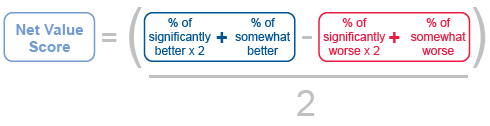
  1. Double the percentage of people that stated “significantly better”.
  2. Double the percentage of people that stated “significantly worse”.
  3. Add the adjusted “significantly better” figure (from step 1) to the percentage of people that stated “somewhat better”.
  4. Add the adjusted “significantly worse” figure (from step 2) to the percentage of people that stated “somewhat worse”.
  5. Subtract the total “worse” calculation (from step 4) from the total “better” calculation (from step 3) to arrive at the Net Value Score.

Calculating The Net Value Score
Brand Value Calculation: Calculating The Net Value Score
The Net Value Score is a composite measure of the brand value. The maximum possible score is 200. Excellent scores are above 60, good scores are between 40 and 60. Scores below 40 indicate a relative indifference to the brand and require urgent attention. The question can be asked of all companies known to a buyer or specifier (customers or potential customers) and it measures perceptions.  These perceptions drive customer choice. The NVS has the added advantage over the NPS of providing a simple tool for tracking the value of a brand over time and providing a very strong indicator of likelihood to purchase.

For more information on the Net Value Score, visit http://www.netvaluescore.com/


The New Metric For Judging A Company’s Success

Thursday, August 18th, 2011


Post to Twitter Post to Facebook Post to LinkedIn

During a recent global branding study for PPG Industries Inc., B2B International developed a set of questions and a unique algorithm, which led to the creation of a new tool providing the market’s perception of benefits and price on brand. PPG Industries – the multibillion-dollar supplier of paints, coatings, chemicals, glass and fibre glass – found the tool so useful, that B2B International branded it the Net Value Score (NVS), and has since used it in a number of studies carried out for the company’s other Fortune 500 clients.

The NVS is a metric that provides the market’s view on the perceived value offered by each company supplying a market. It can also provide the perceived value of a company’s different business units, indicating where the company’s value proposition is seen as the strongest and weakest.

The NVS is based on a calculation that is arrived at through asking just three questions in a market research survey. For each supplier, questions are asked about how the supplier compares relative to other suppliers in the market on (i) its product and service benefits, (ii) its pricing, and (iii) its total value. The data are then run through the algorithm to result in the Net Value Scores.

The tool illustrates the strength of a company’s brand relative to competitors, and indicates where more work is required to improve the level of perceived value – be it through better communicating certain benefits to specific market segments; better differentiating benefits so that they more strongly stand apart from those of competitors; or adjusting pricing so that prices are more in tune with the benefits offered. A company with an NVS which is significantly higher than others with which it competes will be one which enjoys a rising market share.

The NVS can also change the way a company thinks. A supplier is very aware of the benefits offered by its products or services, but these benefits only resonate with the market if people recognise them. In other words, perceptions are shaped by communications. Companies can therefore increase the level of perceived value they are seen to offer by selling on value (such as lifetime cost) as opposed to price. This in particular refers to the sales force and distributors who frequently talk price instead of value.

Patrick Kenny, Vice President of Corporate Marketing for PPG, states, “PPG Industries is fully committed to providing our customers with compelling value and so the NVS is a new metric that provides an ideal way to measure customer-experienced value. It is an excellent, adjacent metric to other popular customer advocacy scores that companies should embrace.”

B2B International is currently building a comprehensive databank of industry-specific Net Value Scores for benchmarking clients against other companies (in both similar and different industries), so that learnings can be shared from those who are performing strongly on perceived value.

Director Julia Cupman, Head of the company’s North American operations, states, “The Net Value Score is an example of our commitment to thought leadership. We hope more companies will recognise the importance of measuring perceived value and that they start benchmarking their performance with the NVS. One should not underestimate the power of this simple tool in providing critical metrics and research findings, which if acted on effectively, can lead to significant business success.”

To learn more about B2B International’s Net Value Score, please visit:

Net Value Score Website www.netvaluescore.com

Net Value Score White Paper: The Metric For Judging A Company’s Success
www.b2binternational.com/publications/white-papers/brand-value-research