

One in five employees has had sex in the workplace, one in three has taken Class A drugs at work, and one in six admit to ‘constantly’ surfing the web on matters totally unrelated to work, according to David Bolchover’s book “The Living Dead”.
He suggests that these employees are bored with their jobs because they don’t actually have anything meaningful to do. He concludes that a successful employer provides workers with a job that is not only inherently meaningful but also has a wider purpose that is closely allied to the organisation’s wider goals. This paper explores some of the theories about employee satisfaction at work and looks at approaches to measuring and addressing the issues raised.
Introduction: How to Measure Employee Satisfaction
Measuring the satisfaction of customers is common practice in the business environment, particularly in the private sector, and most companies recognise the importance of understanding its customer’s perceptions, needs and motivations. However, coupled with customer satisfaction though, is understanding of what satisfies and motivates staff. The link between these two phenomena has been made by many business leaders and theorists alike, indeed some have built their business strategy around this.
Employee well-being is becoming increasingly important as organisations realise the link between happy healthy staff and their long term success.
Nick Marks CIPD
Few would argue that the most valuable resource of any organisation is its people. Staff well-being and their level of satisfaction has been found to directly impact on organisational performance and ultimately organisational success; dissatisfied staff are unlikely to foster a satisfied customer base, and dissatisfied customers directly impact on the bottom line. Thus, measurement of the staff experience is an integral part of developing the customer experience. The link between these issues arose from the premise of the service profit chain:
- Internal quality drives employee satisfaction
- Employee satisfaction drives loyalty
- Employee loyalty drives productivity
- Employee productivity drives value
- Value drives customer satisfaction
- Customer satisfaction drives customer loyalty
- Customer loyalty drives profitability and growth
Source: Harvard Business Review OnPoint
The theory goes that if staff feel valued and involved, customers have great experiences dealing with the service organisation, and then positive business results follow.
The “Contract”
In its simplest form, the “contract” between employer and employee involves the supply of skills and service in exchange for remuneration, with the employer providing the tools to do the job. However, expectations have shifted over time, and both employers and employees now demand more from either side of the equation. The role of two way feedback at all levels within the organisation in developing a happy motivated workforce has been explicitly recognised. Appraisals which prioritise and evaluate work skills and identify staff development and training needs are common place, however, it is not always common place to seek feedback from staff about their level of satisfaction, happiness and/or loyalty to the company/organisation.
Happy Complacency Theory
There has been considerable debate on what employers want from their employees and what employees want from their employers. Early approaches to staff satisfaction tended to focus on the staff member experience; a one way perspective, often quite divorced from the organisational goals and expectations.
Most of us can relay a customer experience when, seemingly “happy” staff, enjoying their place of work, display little interest in serving the needs of the customer or of the organisation. This lies at the centre of the debate about the impact of staff “happiness” at work, and whether indeed, “happiness” is what an organisation should be striving for amongst its workforce.
Our customers don’t pay for us to have a dodgy day, they pay good money to receive a consistent level of service, and so each of our staff has a responsibility to lift themselves and their colleagues. I have learnt that you can only do this when you have champions in key areas – staff who really champion the cause and influence people.
Ian Mahoney, Reebok Club London.
It has been suggested that people who are very satisfied are not necessarily high performers, and with the constantly changing business environment, employees who are too happy and content, feel less inclined to seek improvements, change, or do things differently. In today’s climate, this tends not to be a good position for any business; rather, a company needs staff who are energised, motivated and eager or willing to try something new.
Motivating The Workforce
In order to understand the needs of the workforce, organisations need to understand what is driving behaviours and what are the key motivating factors for staff members. Most work motivation theories are based on the work of Maslow, though the motivational spectrum is wide and can vary over time for different individuals.
Herzberg’s theory is probably the most well known theoretical framework related to job satisfaction. His model identifies basic “hygiene” factors such as pay and conditions which serve to remove the dissatisfaction from work, rather than promote satisfaction. If these factors are not satisfied, it will impact on employee efficiency. The “satisfiers” are factors which motivate staff, give them an incentive to work and have a direct and positive impact on satisfaction, thereby increasing worker efficiency. The “satisfiers” tend to be related to achievement, recognition, responsibility, and the nature of the work that is done.
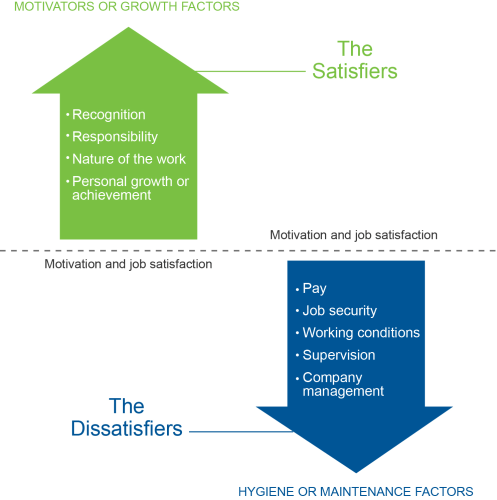
Motivational theories can be helpful in looking at groups of staff and understanding where their motivations lie, though satisfaction at work is achieved through a complex interplay of these variables. High pay will rarely compensate for very poor working conditions and swish, modern offices and good working conditions will rarely compensate for very low pay. Research by Theresa Welbourne at the University of Chicago, identified 4 segments of staff based on their motivations at work:
| Segment | Motivated By |
|---|---|
| Survivalists | Need for income to survive |
| Seekers | Need for good pay coupled with personal satisfaction |
| Contributors | Need to “make a difference” and not motivated by money |
| “Fun”damentalists | Need for work to be fun, enjoy what they do, helps others and part of the work social scene |
Whether or not Welbourne’s segments are recognisable in your company is unimportant, because if you look, there will be segments of employees that can be found.
Staff Engagement
In recent years, research has shown that employers want employees that will do their best at work, even “go the extra mile”, and employees want good work, jobs that are worthwhile and “turn them on”. With this shift, there has been an increasing focus on staff satisfaction as a component of staff engagement.
Engagement is a combination of commitment to the organisation and its values, plus a willingness to help out colleagues (organisational citizenship). It goes beyond job satisfaction and is not simply motivation. Engagement is something the employee has to offer: it cannot be ‘required’ as part of the employment contract. There are many individual and organisational factors that determine whether employees become engaged, and to what extent they become engaged. Although CIPD research found that although there is no definitive list of engagement drivers, the main drivers of employee engagement are:
- Having opportunities to feed your views upwards
- Feeling well-informed about what is happening in the organisation
- Believing that your manager is committed to your organisation
Smart organisations work to develop and nurture engagement as the benefits speak for themselves. It is important to note, the employee engagement process does require a two-way relationship between employer and employee.
Employees who are engaged with the organisation tend to display particular recognisable primary behaviours. They will.
- Speak positively about the organization to coworkers, potential employees and customers
- Have a strong desire to be a member of the organization
- Give that extra effort to contribute to the organization’s success.
Robinson (2004) and Penna (2007) both espouse a model of engagement which incorporates job satisfaction, feeling valued at work, communication and training & development as key influences on staff engagement and overall satisfaction at work.
Robinson argues that satisfaction with the job of work alone, will not produce a satisfied and engaged workforce, but it is a contributory with many other factors. This phenomena can be seen in some positions where the actual job itself is intrinsically satisfying but the place of work is not, for example academics or specialised maintenance trades operating in large organisations. In these situations, the employee feels the organisation does not value the job they do, but they, personally, take great pride in their work, regardless of the company culture and working environment.
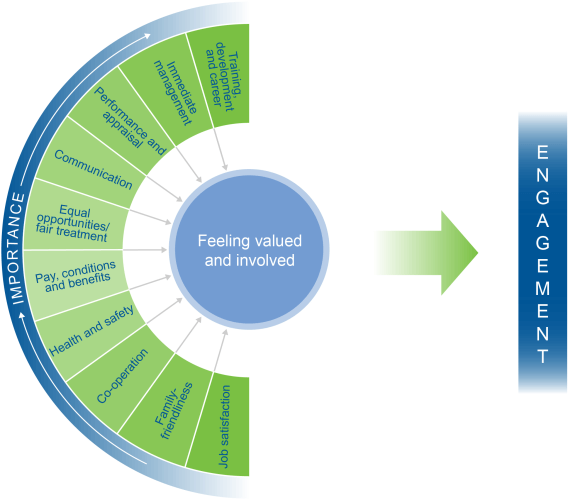
Penna’s model (2007) adopts a similar position. This model indicates that staff are seeking to find “meaning” at work. Penna defines “meaning” as fulfilment from the job. Fulfilment comes from the employee being valued and appreciated, having a sense of belonging to the organisation, and feeling as though they are making a contribution, and is congruent with the underlying theoretical framework of Robinson.
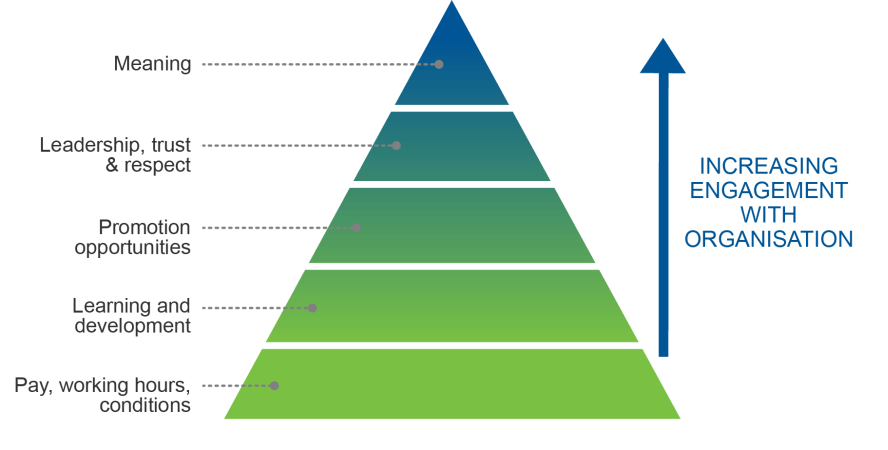
Penna’s model is also remarkably similar to both Maslow’s Hierarchy of Needs, and Herzberg’s theory, with “hygiene” factors at the base of the triangle and “satisfiers” towards the top. As an organisation successfully meets each of these engagement factors, Penna states that the organisation becomes more attractive to new potential employees and becomes more engaging to its existing staff.
Measuring Staff Perceptions
Attracting and keeping good staff is critical to business success. These approaches have highlighted the importance of understanding employee satisfaction and therefore raise issues about how to measure, monitor and improve this within an organisation. A staff satisfaction programme involves 5 steps:
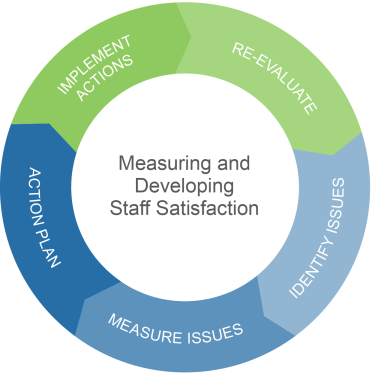
Employee research is the first step in undertaking a programme to improve the working experience of staff and the user experience of customers. It gives employees a “voice” and enables areas of dissatisfaction to be identified.
Employee research methods
Common approaches to measuring satisfaction use a combination of qualitative and quantitative research designs. Although there are a number of “off the shelf” staff survey packages available for purchase, most companies choose a bespoke project design either conducted by an external agency/partner or the in-house HR team.
Qualitative research methods take their roots in the social sciences and are often used in early consultations with staff in order to identify the issues which are of greatest importance, to staff and management alike, which need to be measured. What is important about this consultative stage is that staff have the freedom to express openly and honestly their views about their experience within the company/organisation and what they are seeking, and the survey needs to be reflective of this. The approaches that can be adopted are internal focus groups, depth interviews (face-to-face or on the telephone), online groups and forums.
Quantitative research methods involve samples of large numbers and measurement. It is usual for staff surveys to be census surveys, inviting all staff to participate. The questionnaire is developed from the issues which have arisen from the consultative stage, and the questionnaire will comprise mainly closed questions. The most common distribution route for the staff survey is now the e-survey with paper or telephone options for staff who do not have an e-mail address or access to a computer.
How to Write the Employee Satisfaction Survey Questionnaire
Employee satisfaction surveys will normally cover the key areas impacting on the staff experience. These are likely to include:
- Leadership and direction
- Communications
- “Local” line management
- Staff development opportunities
- Company working culture
- Facilities and environment
- Conditions of service
The rating scales used will usually be determined by the sensitivity of the measurement required. There is no definitive or “correct” way to measure satisfaction, but all scales need to be translated to a numerical scale in order to analyse the results. Some surveys use verbal scales and statements ie
| Strongly agree | Agree | Neither | Disagree | Strongly disagree | |
|---|---|---|---|---|---|
| I always get the support I need from my manager | |||||
| My skills are valued at work |
Whereas others will adopt a numerical scale of satisfaction where the highest score is “very satisfied” and the lowest score “not at all satisfied” ie
| 5 Very satisfied |
4 | 3 | 2 | 1 Not at all satisfied |
|
|---|---|---|---|---|---|
| Support from my manager | |||||
| The extent to which my skills are valued at work |
Questions need to be carefully worded to avoid ambiguity, and if any indicative benchmarking is to be carried out (see section on benchmarking below), the context of the questionnaire must be considered and exact wording of the benchmark question used, in order to make the comparisons.
Reporting will usually be in the form of mean scores of satisfaction and the percentage of staff satisfied, examined across different classifications of staff eg age, level of responsibility, department, location, etc. Additional statistical analysis using correlations, regressions and CHAID analysis can be carried out to identify issues which are driving satisfaction and loyalty, and the relative impact of these issues on satisfaction. In order to carry out this analysis it is necessary to ask particular questions within the survey related to overall satisfaction and recommendation of the company/organisation.
Ensuring the highest response rate:
When carrying out staff consultations and surveys, getting staff on board can be one of the greatest challenges. Poor response rates, insufficient or unclear information and a failure to use the survey to drive actions are just some of the disappointments that are reported. Attention to several issues surrounding the survey can facilitate a positive response:
- CEO involvement and support eg invitation to participate comes from the CEO
- Publicity campaign prior to the survey
- “Heads up” e-mail alerts and team briefings beforehand
- Strong and present management support for the survey
- “Survey weeks” – including support and open access areas for completion (if also used for staff who do not have dedicated computer access)
- Strong internal distribution strategy for paper surveys
- Incentives at the personal level eg prizes etc
- Promise to share headline results very shortly after survey close (bulleted points emerging from survey on topical issues)
If external agencies are used to design and deliver the survey, they too can play a part in ensuring a high response rate:
- Use of recognisable logo associated with the survey
- Assisting the composition of an inviting introductory letter/e-mail
- Ensuring the survey looks attractive and makes answering the questions enjoyable
- Attention to questionnaire wording and length
- Targeted reminders (only to the non responders)
- Survey helpline (especially for electronic surveys)
- “Stop and Save” e-survey options (survey does not need to be completed in one go)
Benchmarking Satisfaction Scores
Benchmarking of employee satisfaction can be carried out in two ways:
- Internal benchmarking: where scores from within the company are compared using the same questions over a period of time (repeat surveying)
- External benchmarking: where scores from other external organisations are taken and compared.
In recent years there has been something of a proliferation of “Best Employer” league tables that companies and organisations can subscribe to. Through the use of a standard questionnaire for employees, they serve as a benchmark against which companies can measure themselves. Some of these surveys are industry specific eg Computer Weekly Best Places to Work Survey, whereas others cut across sectors eg The Sunday Times Best 100 Employers and the Times Top 100 Graduate Employers Survey.
External benchmarking, however, has problems of comparability when taken out of the context of the original survey. It can be very tempting to “cherry pick” questions from several sources where the data from other companies is publicly available, however, questionnaires tend to work in their entirety, and the total composition of the questionnaire therefore has an impact on the results obtained.
The comparability of the measurement scales, the method of delivery and the timing of the data collection also impact on the degree to which comparison can be determined accurately. Finally, it raises questions as to who we should compare ourselves to and which companies should be aspired to in performance. It appears reasonable that any company or organisation should always be striving to achieve the best possible results and therefore place efforts to develop internal benchmarks against which to measure the impact of interventions.
Building An Engaged Workforce
What can be seen from the models relating to the staff work experience is that satisfaction and engagement at work is made up of several factors, some being fundamental or contractual requirements for the organisation (the ‘hygiene’ factors), such as pay and benefits and health and safety, other being the areas where the organisation must ‘go the extra mile’ to ensure effective communication, management and cooperation of and with its employees. When an organisation moves to achieving these, the impact will be seen not only in the attitudes and behaviours of its staff but also in the satisfaction of its customers. In an increasingly competitive world, the ability to find and keep good people will often be the deciding factor between organisational success and failure.
The First Direct Bank and NAGE call centres embarked on a programme to measure and address staff engagement issues. Actions included mentoring, job swap, job shadowing (at all levels in the organisation) and the creation of effective and meaningful feedback opportunities. Both organisations saw positive effects in more than staff retention rates. Bolchover (author “The Living Dead”) regards an employee’s relationship with their immediate manager as the single biggest influence on engagement, and believes that middle managers often lack leadership skills to motivate their staff and make work meaningful. He advocates the development of leadership skills to transform engagement with the organisation.
What is clear from the literature is that current thinking extends beyond job satisfaction. Employers are seeking a workforce which is more than just good at the job they do; they are seeking employees who are engaged with their organisation/company, staff who “buy in” to the company mission and goals. It is also clear that no single factor is responsible for the satisfaction of the workforce and different staff members will be motivated by different aspects of the company offering, and their own approaches to work. The modern organisation sees its people as key assets to be developed and nurtured; they way in which they approach their work and their interactions with customers is critical to demonstrating the brand values of the company. Emergent models of engagement offer an alternative way of approaching employee satisfaction which is more holistic and takes into account the wider needs of both employees and employers.
The higher the level of employee satisfaction, the greater the commitment and contribution to the employer.
Ronan Miles, CEO Oracle UK
Employee research is the starting point in understanding the needs and perceptions of the workforce. The findings can be used to develop the strategy for building a committed workforce who will contribute to the well-being and future security and success of the organisation and avoid Bolchover’s “Living Dead” in the workplace.
Readers of this white paper also viewed:
Employee Research – a Neglected Treasure Trove of Market Intelligence Five Golden Rules for Keeping Employees Happy Stakeholder Engagement: All Together Now