Archive for the ‘Branding’ Category

« Previous Entries   Next Entries »

Great Global Brands

Wednesday, March 23rd, 2011


Post to Twitter Post to Facebook Post to LinkedIn

The annual list of the world’s leading brands has just been published and Google comes out on top. With a brand value of $44.3 billion, the search engine giant is the most valuable global brand in Brand Finance’s annual survey.

Microsoft, Wal-Mart and IBM are the next biggest brands and Vodafone, taking fifth spot, is the UK’s top representative and the largest telecoms brand to feature. HSBC and Tesco are the only two other British brands to appear in the Top 20, which is dominated by US brands – 13 in total.

Apple is a big riser, climbing from $19.8 billion last year to $29.5bn in 2011. Meanwhile, Coca-Cola has dropped out of the Top Ten for the first time, falling from third place to 16th.

This year’s complete Top Ten Most Valuable Global Brands (2011) is shown below:(Click the image for an enlarged version)

Brand Value In 2011


Compare The Market

Thursday, March 3rd, 2011


Post to Twitter Post to Facebook Post to LinkedIn

This week, Emma Flood discusses the advantages of making your brand standing out from the crowd

Earlier this month, I was walking through a large garden centre, when I saw a collection of meerkat statues dressed as various characters, and retailing for around £20. Not in the least bit interested in purchasing one of the bespectacled fluffy mammals, but having seen them on sale in various other outlets, I pondered the sudden interest.

If you’re a UK dweller, you will probably recall an ongoing advertising campaign for a financial comparison website, comparethemarket.com, who, in a bid to differentiate themselves from their comparison site rivals, launched a sister website, comparethemeerkat.com. The meerkat story follows Aleksandr Orlov, a talking meerkat and face of comparethemeerkat.com, on his travels across Russia. Such has been the success of this advertising campaign, Aleksandr Orlov’s autobiography reached number one in The Sunday Times Bestseller Chart over Christmas 2010, and meerkat lovers have also downloaded his iPhone app, bought his ringtone, and followed him on Twitter. Presumably this meerkat love affair is also driving demand for these fluffy meerkat statues I see so frequently…

You are probably wondering, as I did, what on earth meerkats have to do with financial comparison websites? Let me take you back to the inception of the UK’s first comparison website – confused.com. Part of the Admiral Group, confused.com was launched back in 2002 focusing initially on comparing car insurance quotes, and growing to now run comparisons for most consumer insurance types, as well as for products such as credit cards, savings accounts and mortgages.

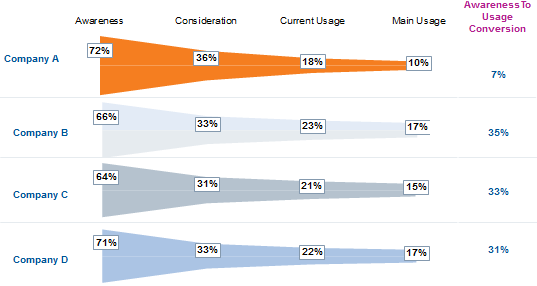
Not long after confused.com was established, others jumped on the bandwagon, offering very much a “me too” service. After a while, I myself became confused by the plethora of comparison sites available, and struggled to remember the names of the websites, given the similar sounding domains such as: comparethemarket.com, gocompare.com, moneysupermarket.com etc. I speculate that around this time some research was conducted to understand awareness and usage of these comparison sites, and how or if consumers were able to differentiate between them and remember the particular domain names. If I’m right in thinking that research was carried out, then I might also be right in assuming that the research concluded with the view that consumers were baffled by the array of sites and similar sounding domains, leading to a recommendation for the commissioner of the research to find a way of differentiating either their offering or their message.

Thus, we understand the concept behind Aleksandr Orlov and his meerkat family. Brainchild of the VCCP Agency, and with a concept so far removed from financial comparison websites, we can’t help but remember the meerkat family and even simply typing “meerkat” into Google leads us directly to their comparison site.

Threatened by the success of this advertising campaign, the other comparison sites had to carve out their own niche – regardless of how unbearable it might be for consumers to watch. Enter gocompare.com. Welsh tenor Wynne Evans sings “Go Compare!” at the top of his voice. Annoying? Yes. Memorable? Unfortunately so.

Moneysupermarket.com haven’t quite managed to create such a memorable advertising concept, relying on the faces of Dragon’s Den’s Peter Jones, Iranian Comic Omid Djalili and most recently “Jedward” from X Factor and their matching bouffants.

The founders of the original comparison site, confused.com, seem as unable as moneysupermarket.com to carve out a unique and memorable theme, moving from adverts portraying customer testimonials to the current singing cartoon characters. Although they proclaim a following of “20 million users” (I can only assume this means the amount who have registered since 2002), the success of their campaign falls far behind that of Aleksandr Orlov and his meerkat family.

The story of these comparison websites’ successes and failures leads me to think about the importance of ensuring that your business has a strong and distinguishable position in the marketplace. In the case of these websites, it was difficult to differentiate between each, until one stepped forward with a unique “offer”, albeit unlikely. If your offer is not seen as different or better than your competitors, what reason do customers have to choose you, or remain with you? And what is stopping them from switching to a competitor who is positioning themselves as unique or superior to you? Often businesses are not aware of how they are perceived in the market, either by their customers or potential customers. At B2B International, we pride ourselves on providing market research with results that are strategic in nature in order for you to implement improvement and grow your business. To see our full range of services and understand how B2B International can improve your position in the market, visit: http://www.b2binternational.com/research-and-intelligence/


Package Deal

Tuesday, February 22nd, 2011


Post to Twitter Post to Facebook Post to LinkedIn

An important element of the marketing mix is packaging. It can certainly be argued – and indeed we do so in our white paper Why Is Business-To-Business Marketing Special? – that packaging plays a much greater role in consumer markets. Yet, as marketers, we should never completely overlook the packaging element of our offering, which is why the following article, written by marketing consultant James Black and recently published in AdAge, caught our eye:

What Is Your Product Saying to Consumers?

Rethinking the Role of the Package in Communications

Two fundamental truths about packaging are routinely overlooked by marketers. First, packaging is the only marketing vehicle that 100% of the consumers who buy your product see. Not every consumer sees the brand’s advertising or is exposed to the exciting social media that your brand is doing. But all of the consumers who buy your brand do interact with your humble package.

Second, and equally important, the package is really the only vehicle that you have 100% control over in-store. While your product can end up in the wrong location or shelved in the wrong direction, the package remains a constant, and once it has a consumer’s attention, it starts conveying your message. Displays may not make it out to the floor, or may not be assembled correctly, or can be overlooked by the shopper; indeed, shelf vehicles may be missed altogether. Thus, it is vital to get the communications right on the package. The first step is to decide what message you want packaging to convey to consumers.

Many marketers assume that the role of the package might be to “stop the consumer” or to “close the sale.” But if we explore further and ask “who is the consumer?” and “how do we intend to close the sale?” we reveal a variety of roles for the package.

Let’s take a look at just three. A package can attract new users rather than just retain current users, often a truly artful balancing act. A package can also be updated to communicate a new positioning for the brand. And third, packaging can close a sale with the consumer in store.

Attracting new consumers vs. retaining current ones

First, it’s important to understand whom the consumer is that we are trying to engage. Is it current consumers? New users? Are we trying to transition the brand from one user group to another? These directions give way to different design strategies and considerations.

Consider, for example, the relatively recent launch of the “U” feminine care products by Kotex. These black packages easily draw attention from shoppers at shelf amidst a sea of predominantly pastel packaging from other players in the category. Indeed, cleverly designed windows on the package reveal pastel packets inside, a cue to category norms. Thus a new to the category brand effectively communicates to consumers by being both differentiated from the category and relevant at the same time.

In contrast, recall the much talked about Tropicana redesign that was hastily withdrawn from market earlier last year. The design was so disruptive that it was not easily recognizable to current users, who were likely to just “grab and go” in the juice refrigerators. As a result, alienated shoppers did just “go,” and the brand lost significant volume overnight. Ultimately, brands must strike a careful balance in keeping the brand recognizable to current users while also making it disruptive to new users. As it appears, Tropicana weighed communicating to new users over driving recognition, and missed achieving that critical balance.

Communicating a new positioning for the brand

In 2009, Bath & Body Works re-staged its core Signature Collection line. With the update, the packaging was designed to communicate that Bath & Body Works was more sophisticated, more elegant and more premium, also supported by improved product formulations. Additionally, the packaging played a key role in supporting new and improved in-store marketing and navigation. Here, by integrating package design, product design and in-store marketing, the brand was able to holistically communicate a new positioning.

According to the company, successful test-market sales led to a nationwide rollout and the company also witnessed improved perceptions of the brand in equity measurements.

Closing the sale

In order to close a sale, it is important to understand how the consumer will respond to simple claims vs. the need for extended education at shelf.

Here, consider how the “five” subline by Haagen Daz is brought to life. The packaging does a fantastic job of underscoring a key brand equity point around premium-ness and pure goodness by simply listing five core ingredients prominently on the front of the package: milk, cream, sugar, eggs and whatever the natural flavor is. And to the earlier point, it is key to advance this message without disparaging the parent brand.Additionally, the package conveys a basic idea so simply that it is very effective as the “hero” in the brand’s print advertising.

Is your packaging achieving the goals you have for your product? If not, it might be time to revisit what your products are communicating from store shelves.


Gossip Girl

Friday, November 19th, 2010


Post to Twitter Post to Facebook Post to LinkedIn

In this Thursday night insight Cristin Malone discusses how a bad habit lead to a refreshing view on market research

This past weekend I took part in something that I am ashamed to admit. It’s a little embarrassing. I was overtaken by something that is completely unnecessary, totally fabricated, crude and at times disgusting: you may know it as “celebrity gossip”. It all began with my favorite sweats, my couch, and my decision to re-watch episodes of Sex and the City (aka SATC). As a die-hard SATC fan, I have seen every episode at least twice, so it was very easy for me to be distracted by the fashion and gossip magazines neatly stacked on my coffee table.

At first I began skimming through “quality” magazines, Vogue, Elle, Bazaar, then I downgraded a little and skimmed through Cosmopolitan, and ended with an old Esquire magazine that had Katy Perry on the cover. Luckily my in-take of celebrity gossip ended there and I didn’t make it to People, Teen People, or Star magazine. However, my reason for why I stopped reading is just as embarrassing as admitting I read gossip magazines. After skimming through Esquire, I got up went to my computer and actually googled Katy Perry. Yes, I googled Katy Perry.

I actually forgot why I was looking her up, because as I typed in Katy Perry’s name in Google’s instant search, it appeared as “Katy Perry (Hudson)”. Intrigued I continued with the “Katy Perry (Hudson)” search and found out that the singer was originally named Katy Hudson, and prior to her career as a pop performer, she was a Christian singer.

Wait, a Christian singer? Prior to singing about kissing girls and liking it, she was singing about the Lord? How, and I mean how did I not know this? So I called a few friends and realized I was late to find out this piece of information and also realized that many of my friends had a moral issue with Katy’s change in identity. I wasn’t at all bothered by the fact that she changed her image, but more concerned with the how. How did she re-brand herself so effectively? What actions did she take? And how did she know when and where and how to do those actions? My interest became less about Katy Perry and more about the concept of re-branding.

The more I thought about it the more evident it became that Mrs. Perry (she recently wed Russell Brand – there is some gossip for you) did not forgo her transformation from church girl to pop star alone. Her re-branding required an in-depth understanding of the music industry, including:

• What type of songs to sing?
• What type of music listeners to target?
• How to reach her target market?
• Unmet needs of music listeners
• Barriers to enter the music industry
• Discovering a niche in the market
• What her physical image should be?
• Among other key understandings

There is no way she went from Katy Hudson to Katy Perry without having a team of experienced and knowledgeable professionals behind her. Then I thought she chose her team wisely, but what if she hadn’t? Would she still have become a star?

That’s when I really came to love what we do here at B2B International. We play that supportive role to our high level, intelligent, and talented clients. While we may not be able to make our clients pop stars, we always strive to combine our research and consultancy experience to deliver effective brand strategies to our clients. As seasoned and knowledgeable market researchers, we provide our clients with actions on how to re-position and brand themselves as they enter new markets as well as help them discover their niche as they take on market challenges and the restructuring of their image.

The reality is that no matter the industry, the market is always evolving and success is often contingent upon maintaining a brand or an image that is current and forward thinking. The brand represents what the company is and so as a business continues to establish or re-define its image, it’s important to have the right people on your team, because what’s the point of re-defining your image if it’s only going to be a one-hit wonder?


Anyone For A Bucksstar Coffee?

Friday, November 12th, 2010


Post to Twitter Post to Facebook Post to LinkedIn

On his latest trip to China Mark Hedley discusses the impact of the brand names of the western world and how the growing market of copycat products is helping to reinforce these global brands.

On one wet and rainy Sunday afternoon in Beijing last month, I decided to go and try to pick up a local Chinese gifts for friends and family back in Britain. Unfamiliar with the best shopping locations in the city, my hotel concierge recommended I take a stroll down to the pearl market, located just a few blocks away from my hotel. The market was overwhelming – a five storey building the size of a multi-storey car-park, packed full of small stalls selling all manner of traditional Chinese ornaments, memorabilia, clothing, jewellery and so on. This was the kind of place where you could buy everything from Chinese teacups, to aviator shades, knock-off golf clubs and a laser telescope.

Anyone that has ever visited China will be familiar with the noisy and irritating cajoling from sales girls with a minimal grasp of English and pushy attitude. Feeling like I’d walked onto on the floor of the New York Stock Exchange, I hastily beat a retreat towards the exit, until I was stopped in my tracks by what seemed to be an I-pad (that most coveted of modern gadgets) being sold for a draw-dropping $150 (about 5 times cheaper than those in the UK). Fumbling for my wallet in hasty excitement, I suddenly noticed that I was not looking at a genuine bona-fide I-pad, but was actually something called an ‘A-Pad’…

What is an A-pad? Well, to briefly explain, over recent years, China remarkable economic expansion has led to the gradual opening up of the consumer economy to a whole host of global consumer brands, from Apple, and Microsoft, to designer brands like Burberry and Louis Vitton. This booming appetite for branded consumer goods has also been accompanied by the rise of ‘Shanzhai’ phenomenon. A fairly recent phenomenon, ‘Shanzhai’ can roughly be translated as ‘Mountain Stronghold’ or ‘Mountain Village’ refers to near copies of famous brands or products, but where the brand name or design has been slightly altered or modified slightly from the original brand. The easiest place to spot this Shanzhai phenomenon is in China’s countryside, where many of the products are produced and sold at prices far below the original brands.

Originally shanzhai was mainly used to refer to the cheap mobile phones and digital devices produced in and around the manufacturing hub of Shenzhen. However, over time the concept has developed to refer to anything that imitates or spoofs a famous brand, and often contains more than a dash of rebellious humour. Some of the more amusing examples of include a southern fried chicken chain store named ‘KFG’, the ‘Buckstars’ coffee chain, and a search engine with a vaguely familiar web address: ‘Goojje.com’. There have been Shanzhai versions of Hollywood movies, Shanzhai celebrities and a Shanzhai version of the 2008 Beijing Olympic opening ceremony.

Although the Shanzhai phenomenon no doubt terrifies the vast majority of Western corporations keen to protect their intellectual property rights in China, if nothing else it does serve as an ironic reminder of the power of the brand to penetrate even the most remote and insulated of markets without any real marketing. In actual fact, rather than diluting the power of the brand, the Shanzhai versions actually serve to help to reinforce these global brands by duplicating and popularizing them with a large group of potential future consumers.

Over the next few years we will see rising incomes in developing markets like China, with more and more people lifted into the middle classes, and this should result in a growing number of companies shifting from Shanzhai consumption towards mainstream consumer culture. Although part an ironic rebellion at the high cost of luxury brands to the majority of Chinese people, more importantly the shanzhai phenomenon expresses the deep aspiration for material wealth among the Chinese peasantry that will one day reap huge rewards for Western brands that can learn to position themselves correctly.


« Previous Entries Next Entries »