What is value marketing?
The past decade has been a challenging one for business-to-business marketers in North America and Europe. The worldwide financial crisis, cheap Asian competition and the rise of online marketing and commerce have made most markets more competitive than ever and put huge pressure on margins. In many businesses the response to these challenges has been one of resignation – an acceptance that prices have to be reduced, margins squeezed and businesses less profitable. We at B2B International vehemently disagree with this view.
While it is true that cheap competition is more prevalent in b2b markets than ever before, this is balanced against another converse trend: the requirements of b2b decision makers are more sophisticated than ever before. Business-to-business decision makers are increasingly knowledgeable and increasingly discerning. Since 2007 we have seen the polarization of many business-to-business markets: the minority of price buyers are more price-focused than ever; simultaneously the majority of the market – value buyers – are more discerning than ever, with elevated needs based around service, brand and consultancy.
Figure 1 below illustrates how b2b suppliers increasingly base their offers around knowledge-based services. In Western markets, previously product-based industries such as IT and printing now predominantly offer services. This is in direct response to the shifting differentiating needs of b2b customers, which are moving Eastwards to ultimately encompass a range of sophisticated emotional needs. Relatively sophisticated needs that were previously regarded as differentiating needs are now simply hygiene factors, automatically expected in order for a provider to even enter the consideration set.
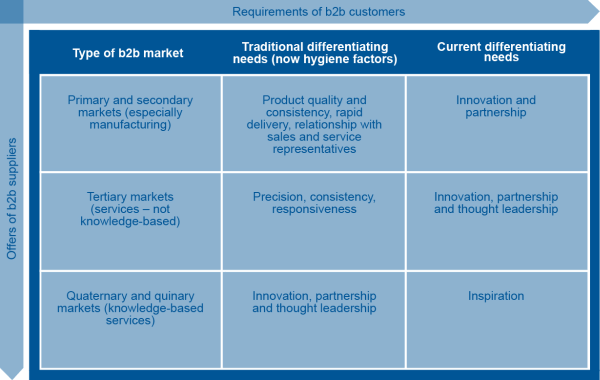
This provides a greater opportunity than ever before for sophisticated businesses to differentiate themselves through value marketing and value selling. The ten points below illustrate how to market and sell your offer around value rather than price, and can be applied to any b2b market.
-
Decide who you don’t want to sell to
Business-to-business marketers know well that segmentation is all about aligning different propositions against groups of customers with different needs. Segmentation facilitates customer choice. Less recognized is the fact that segmentation also facilitates choice for us as b2b suppliers: the choice as to who to do business with and who not to do business with.
As marketing is the profitable satisfaction of customers’ needs, customers or segments who will not provide us with the margin we require should be deselected. Just as customers are entitled to become increasingly discerning, so too are we as suppliers.
Detailed definition and analysis (both market analysis and financial analysis) of your segments built around rigorous market research is the first, crucial step in deciding which customers you wish to serve.
-
Sell outcomes, not products
Consumer marketers have long recognized that selling outcomes rather than products and their features is the path to higher margins. Firms that used to sell sports shoes now sell dreams of success or better wellbeing; perfume companies sell romance, sophistication or both. These outcomes are valued far more by consumers than the actual products that achieve these outcomes.
Despite their protestations, business-to-business customers are similarly looking for outcomes: a buyer of IT equipment might require greater business efficiency; a buyer of recruitment services may actually be looking to buy business growth. Savvy b2b marketers ask themselves and colleagues “What are we really selling?” and build their marketing and sales approaches around these outcomes. Product features may be used to substantiate the outcome that is being sold, but should not form part of the message per se.
-
Be clear on what the customer will pay for
Surprising numbers of business-to-business companies conduct no systematic research into customer requirements, and many fail even to consider that customer needs may change over time. This, not falling prices, is the reason for many business-to-business companies failing. Up to half of all companies in many b2b sectors continue to operate under the delusion that ‘product quality and price are all that matter’. Falling market share and diminishing margins are usually the result.
The cause of this misunderstanding is frequently sales teams, who are widely listened to in b2b companies. Emboldened by their access to the customer and driven by short-term targets, b2b salespeople frequently misunderstand, oversimplify and miscommunicate customer needs.
Independent market research and a more long-term, marketing-oriented mindset are good ways of improving the business’s understanding of customer requirements.
-
Business buyers have emotions too
It is true that business-to-business customers tend to be less whimsical than consumers, and that their purchases tend to be less conspicuous. Yet emotions play a huge part in business-to-business purchase decisions.
Risk aversion, respect and patriotism are all emotions weighing heavily on buyers in many markets, and reflect an emotional need for reassurance that the seller shares similar values and that the buyer is making the right decision. It used to be said, for example, that ‘you never get sacked for buying IBM’. Surveys of products in most b2b markets show the relationship with the account manager as one of the main drivers of both supplier choice and customer satisfaction. Surveys of French b2b buyers frequently show ‘being French’ as a top requirement, while in China ‘being from a Western country’ is a key driver among many engineering buyers.
In addition to reassurance, a second category of emotional need is now developing among business-to-business buyers – the need for ‘a future together’. The choices available to b2b customers are increasing, economic cycles are shortening and job markets are becoming less secure. In parallel, a sophisticated understanding of cost-in-use and product life cost has developed. In response to this, customers increasingly require suppliers that will help them make the next innovation, tackle the next new market or create the next business model. In most b2b surveys, ‘innovation’ and ‘partnership’ are key needs, and usually they are insufficiently met.
-
Be a storyteller
In looking for outcomes, business-to-business customers require a compelling, complex and multifaceted proposition comprising features, products and services, and providing emotional fulfillment. Business-to-business marketers and salespeople need to be able to knit these components of the proposition together seamlessly in order to make the ‘outcome’ they are looking for defensible and compelling. The same compelling story must be told to different parties within the decision making unit in a way that engages each of them. We must touch the ‘hot buttons’ of both the technical buyer and the commercial buyer, while maintaining coherence from start to finish. Rather than bombarding customers with a simplistic price/quality message, marketers and salespeople must take on the role of storytelling chameleons, clearly communicating complex propositions to complex decision making units.
-
Target the highest decision-maker possible
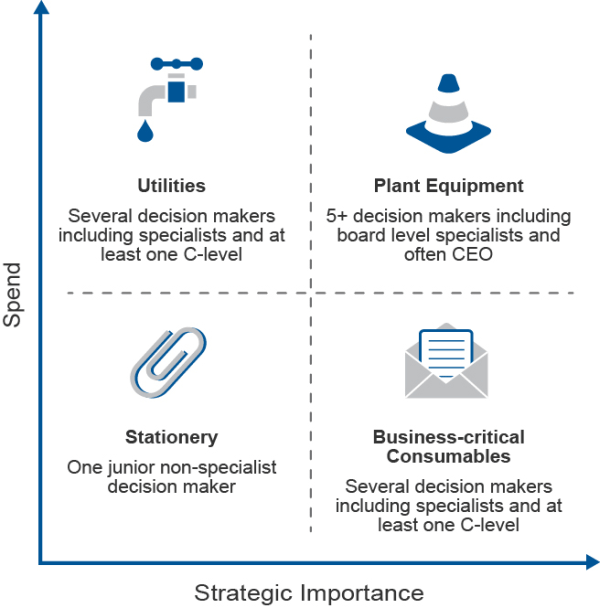
Before selling and marketing on value, it is vital to establish an intimate understanding of the customer’s decision making unit. In particular, it is important to establish the most senior person who will place value on the offer. Targeting high increases the chances of making a big sale; more importantly, decision makers in strategic positions are most likely to think strategically about the offer and therefore place value on it.
The matrix below helps identify who the most senior decision maker you can target is likely to be, based on two key variables of (1) the strategic importance of your offer to the target customer and (2) the proportion of its overall budget the target customer places with you.

-
Communicate the ROI of your proposition
Key to value marketing and selling is moving the conversation away from transaction price. As well as articulating the outcomes and benefits of the offer, we should also talk about return on investment. If you are selling a more expensive industrial pump than your competitor, how much will the customer save in reduced downtime? If you are selling marketing communications services, how much extra revenue do you think you will generate and why? Most b2b purchases are made with ROI in mind. We must communicate our offers in terms of quantifiable units and, if possible, in financial terms. And we must be absolutely credible in doing so.
-
Never bargain
It is impossible to market and sell an offer on a value basis long-term if you submit to requests to ‘do a deal’. Willingness to bargain by definition reduces the perceived value of the offer in your customers’ eyes, and in business-to-business markets word travels fast. B2b marketers often justify their willingness to bargain on the grounds that their product is perishable. This is particularly the case in the quaternary and quinary businesses, who are essentially selling time. However, bargaining on hourly rates is a sure way to make your entire proposition perishable and create a ‘race to the bottom’ in your market. Even reducing your offer to reflect a lower price is fraught with difficulty. Value selling works when a coherent package of benefits is communicated. Deconstructing this package into its component parts reduces the coherence of the offer and removes the synergies achieved by putting a package of complementary benefits together. Losing these synergies further devalues the offer in the eyes of the potential customer.
-
Remember that for most b2b buyers, it is NOT all about price
Data gathered over 15 years at B2B International shows clearly that the average proportion of any market that prioritizes price over all other issues is 20%. 80% of business-to-business buyers do not prioritize price. In other words, price-focused salespeople are leaving value on the table in 80% of cases! Even in highly undifferentiated markets such as utilities, fewer than half of buyers prioritize price. The myth of the price-focused market is perpetuated by simplistic b2b salespeople who only know how to sell – or only want to sell – on price.
-
Be prepared for a cultural change
The biggest challenge of value selling and value marketing is that it can only be achieved if it is deeply embedded in the company culture; part of the DNA of the business. However, in most b2b markets, the limited size of the target audience means a labour-intensive marketing and sales process; with a heavy emphasis on salespeople, volume and short-term results. Value marketing and value selling require a reversal of this approach, with marketers joining salespeople as the ‘heroes’ of the b2b business, profit supplanting volume as the number one KPI and a longer-term outlook communicated from the top of the business.