Factor analysis is a statistical technique that helps insight teams make sense of complex survey data. In B2B research – where questionnaires often capture dozens of attributes, attitudes, and service metrics – factor analysis groups related variables into a smaller set of meaningful “factors” (latent themes) that explain how customers really think and decide.
This lets you move beyond long lists of questions and focus on the few core dimensions that drive satisfaction, loyalty, brand perception, and buying behavior.
What Is Factor Analysis? (And Why It Matters in B2B)
B2B markets are complex: multiple stakeholders, long buying cycles, and nuanced product/service requirements. Factor analysis reduces complexity by finding patterns in how respondents answer survey questions and grouping those questions into underlying factors – for example, responsiveness, technical competence, or ease of doing business.
Why it matters:
- Clarity for decision makers: Turn 40 variables into 4 strategic themes.
- Better KPIs: Measure and track the factors that actually move the needle.
- Stronger storytelling: Explain performance and priorities in plain language.
How Factor Analysis Works
At its core, factor analysis:
- Identifies correlation patterns between survey questions.
- Groups related questions into factors (latent variables).
- Shows how much variance each factor explains, so you can see which themes matter most.
- Outputs factor loadings, indicating how strongly each question contributes to a factor.
- Optionally applies rotation (e.g., varimax) to make factors easier to interpret.
You don’t need to be a statistician to benefit from it – the outcome is a clean, simple framework for your insight narrative and KPI design.
Exploratory vs. Confirmatory Factor Analysis
Exploratory Factor Analysis (EFA)
- Purpose: Let the data reveal the structure.
- Use cases: Customer satisfaction studies, brand perceptions, segmentation inputs, questionnaire optimization.
Confirmatory Factor Analysis (CFA)
- Purpose: Test and confirm a hypothesized structure.
- Use cases: When you already have a theory (or prior EFA results) and need validation – often within Structural Equation Modelling (SEM).
When to Use Factor Analysis in B2B Research
Common B2B scenarios where factor analysis adds value:
-
Customer Satisfaction & CX: Identify the core drivers behind NPS, satisfaction, and loyalty.
-
Segmentation: Reduce dozens of attitude statements into a small set of psychographic dimensions for robust segment models.
-
Brand Tracking: Uncover the pillars of brand equity (e.g., trust, technical leadership, partnership).
-
Product & Service Development: Group features into logical themes to prioritize roadmaps.
-
Voice of Customer: Distil recurring themes in attitudinal metrics to focus improvement efforts.
A Simple Example: Factor Analysis in Action
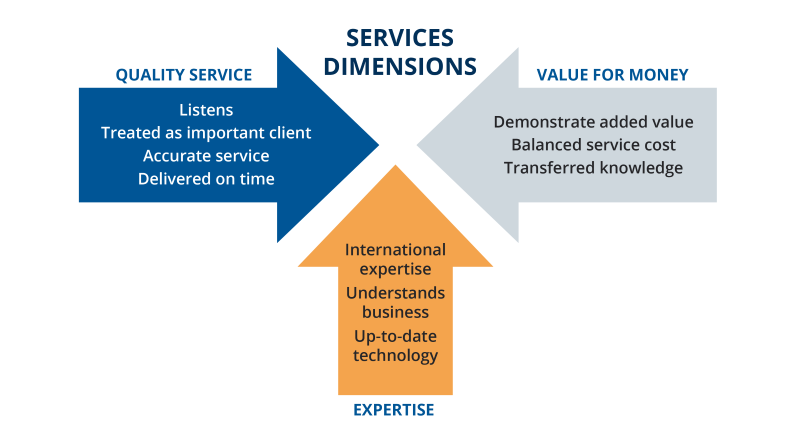
A global professional services firm surveyed 1,200 B2B clients on 25 service attributes. Factor analysis condensed those attributes into three clear dimensions:
- Operational Reliability – accuracy, timeliness, dependable delivery
- Technical Expertise – domain knowledge, problem solving, quality of advice
- Ease of Doing Business – responsiveness, communication, flexibility
The firm rebuilt its dashboard around these factors, set clearer KPIs, and targeted improvement initiatives at the factor level – leading to faster executive buy in and measurable gains in satisfaction.
Benefits for B2B Insight Leaders
- Simplify complex datasets without losing meaning
- Highlight true drivers of satisfaction, loyalty, and preference
- Build stronger segmentation and reduce noise
- Shorten questionnaires while retaining the insight “signal”
- Improve executive alignment with a clear, factor based narrative