In today’s competitive B2B landscape, understanding how your brand delivers value compared to competitors is critical. Customers don’t just buy products – they buy perceived value. That’s where the Net Value Score (NVS) comes in. Developed by B2B International, NVS is a proven metric that helps businesses measure and improve the value they deliver to customers.
What Is the Net Value Score (NVS)?
The Net Value Score is a simple yet powerful way to quantify how customers perceive the overall value your company offers. Unlike metrics that focus solely on satisfaction or loyalty, NVS zeroes in on value – the balance between the benefits customers receive and the price they pay.
Why does this matter? Because in B2B markets, value drives everything: customer acquisition, retention, and ultimately, profitability. If your brand isn’t delivering superior value, competitors will.
Why Net Value Score Matters for B2B Brands
For B2B organizations, brand value isn’t just a marketing buzzword – it’s a business imperative. Customers choose suppliers based on perceived value, and they stay loyal when that value is consistently delivered. NVS provides:
-
A clear benchmark: Compare your performance against competitors, industry averages, and global leaders.
-
Actionable insights: Identify whether your pricing, benefits, or overall proposition needs improvement.
-
Strategic direction: Use NVS data to refine your value proposition and strengthen your brand positioning.
How Is Net Value Score Calculated?
The NVS methodology is straightforward but insightful. It’s based on responses to three key questions:
- Benefits – How do your product or service benefits compare to competitors?
- Price – How do your prices compare?
- Total Value – Considering both benefits and price, how does your overall value compare?
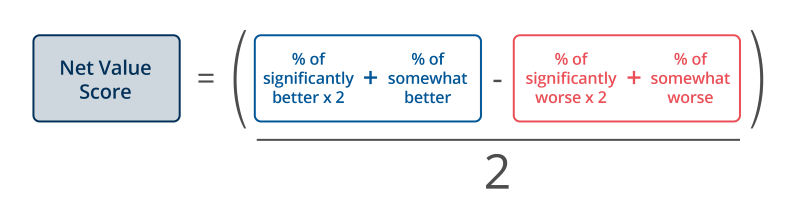
Respondents rate your company against competitors using a scale from “Significantly better” to “Significantly worse.” From these responses, the NVS is calculated using this formula:
- Double the percentage of “Significantly better” responses.
- Double the percentage of “Significantly worse” responses.
- Add “Somewhat better” to the doubled “Significantly better” figure.
- Add “Somewhat worse” to the doubled “Significantly worse” figure.
- Subtract the total “worse” score from the total “better” score.
- Halve the result and express it out of 100.
Interpreting Your Score
- 60+: Outstanding
- 40–59: Excellent
- 30–39: Good
- 20–29: Moderate
- Below 20: Poor – improvement needed
How Businesses Use NVS to Drive Growth
Leading B2B brands use NVS to:
- Benchmark performance across regions, industries, and competitors.
- Identify gaps in perceived value and take corrective action.
- Enhance pricing strategies without sacrificing competitiveness.
- Strengthen brand messaging by highlighting benefits customers value most.
For example, global manufacturers and service providers have used NVS to uncover hidden weaknesses in their value proposition, leading to improved customer retention and higher margins.
NVS vs Other Metrics
You might be familiar with Net Promoter Score (NPS), which measures advocacy. While NPS is useful, it doesn’t tell you why customers promote – or don’t promote – your brand. NVS fills that gap by focusing on value, the ultimate driver of loyalty and growth.