

I assume that because you are reading this white paper that you operate in a business to business market. I can confidently guess that you could volubly describe to me your company’s product (or service) together with the many product variations you can offer. You could no doubt also tell me the prices of your products. There would be no problem asking you to describe the channels by which your products get to market. However, if I was to ask you how people get to know about your products and the campaign effectiveness of your many and scattered forms of promotion, I am sure that you would need time to think about your answer.
Business Promotions: The Role Of Promotion In Business-To-Business Markets
There must be more misunderstood money spent on business to business promotions and B2B advertising than on anything else in the marketing budget. Maybe your promotional spend is excessive; maybe it isn’t enough. What we do know is that it is difficult to measure campaign effectiveness and very few people even try.
Let us begin by thinking our way through the way that B2B promotions work. The AIDA model helps in this respect. This hierarchical model follows the decision making process from lighting the lamp for people through to the sale itself. At each level in the process the numbers of people dramatically reduce so that those who take action are a small fraction of those who are aware of or interested in the product.
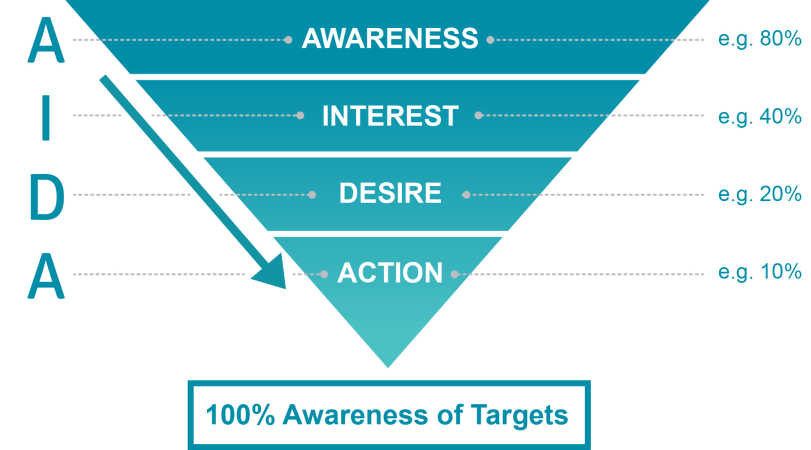
The AIDA model is also important because it gives us four levels to measure and explore when we are looking at the effectiveness of business promotions.
Those of you who have been following the B2B white papers will know that one of the key characteristics of business to business markets, that distinguishes it from consumer markets, is the complicated DMU (decision making unit) within industry. There may only be one person placing an order within a company but almost certainly there will be one or two others influencing the decision in their own special ways. A production person may approve or veto products that are effective in the workplace. Someone else could endorse companies with the appropriate financial stability to be a supplier. Yet a further person could impose conditions on health and safety issues. Advertising market research requires us to understand the role played by the different parties in the DMU and how they are influenced by promotions.
A typical business to business promotional campaign may have a budget of just a few thousand pounds. £50,000 is a large campaign. There is good reason for this. The target audiences for business to business promotions are small in number and measured in their thousands and not in millions as is the case with our consumer cousins. With this small number of customers in their sites, the best means of contacting the larger accounts is in person. Not surprisingly, therefore, consumer and business to business companies spend significantly different amounts of their promotional budgets on different types of B2B promotions.
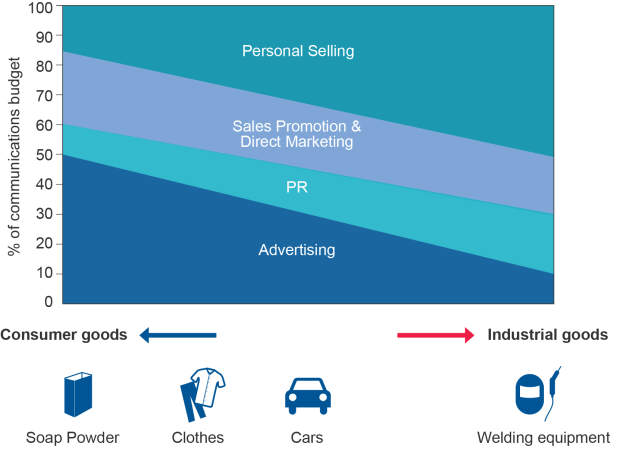
The other point to make by way of an introduction is that promotions have different objectives at different times in the product life cycle. At the beginning of the life cycle, promotions are designed to build awareness and establish the credibility of products and in later years the promotions have to sustain demand. Any consideration of the campaign effectiveness of promotions must have the objective of the promotion in mind.
How To Test The Campaign Effectiveness Of Promotions
There is much that market research can do to improve and to measure campaign effectiveness. So why is it hardly ever used in business to business markets? The reason, sadly, is money. An advertising testing research study, designed to improve the effectiveness of a promotion, may cost as much as the business promotion itself. Understandably, many B2B marketers question spending so much on intelligence gathering, preferring to suck it and see.
At the time of writing this paper we have just finished a piece of advertising effectiveness research into a new brochure. The cost of the research was £7,000 – as it happens, equal in value to the cost of the brochure and the mailing. However, in this case our client believed that the research was justified because of the learning gained from the research and the value that this could have for other parts of the business. Also, the brochure was one of a series to be used in modified forms within the Group. The total spend on the promotion in all its variations could be closer to £100,000. Not least, our client was sufficiently far sighted to recognise that if the brochure was launched without advertising market research and failed to draw business, it would not only waste the £7,000 incurred in the print, design and the mailing, it would also cost in terms of the business that was never won. Conversely, just a couple of projects won as a result of an effective brochure would pay many times over for both the cost of the brochure and the research.

Before I describe how advertising market research can help test the effectiveness of promotions, it is worth thinking about how market research can be used to find out what will make an effective B2B promotion in the first place. Most promotions are creative ideas (sometimes not so creative) developed by the client company or its advertising agency. Once the creative idea is born, it quickly becomes adopted and translated into the promotional device – the piece of literature, the advert, the exhibition stand etc. However, what if the creative platform is wrong to start with? Communications research carried out at an early stage can generate the creative ideas for the promotion. These ideas are best generated by focus groups which spark debate and thoughts.
Of course, many business to business markets are limited in size with customers and potential customers scattered over a wide geography. In order to persuade 8 such people to sit around a table and join a focus group, there needs to be a local population of 50 companies from which to recruit. On the occasions (and there are many) where there are no such clusters, other options have to be considered. Face to face and telephone interviews provide suitable options for exploring creative platforms as they allow projective questions, open discussion and lots of probing. At this stage the emphasis is on good qualitative research that flushes out ideas.
Before a piece of literature or an advert is finalised, market research can be used to determine the campaign’s effectiveness. It isn’t necessary to show the mock-ups to hundreds of people, 20 or 30 target respondents is a fair test. This number will spot if there are features that are failing in terms of interest, impact or clarity.
Comments such as these about the front cover of a new brochure would give a clear signal that some changes are needed:
It is just two guys kidding around, posing. It is false. I don’t know what they are up to… It does not give any information.
“It looks staged.”
“I don’t think a lot of the front cover. It’s too general like a lot of marketing literature. I get five pieces like this on my desk every day”
The same approach can be used to test intended adverts. In a recent project we had to find the most effective advert out of 6 possibilities. The ad testing research was carried out amongst a target audience of 100 buyers in businesses. The telephone was used in the first stage to recruit and qualify respondents. The next step involved the mailing out of the six adverts to each respondent and finally, a follow-up interview asked key questions:
- What are first reactions to the advertisements
- What are the “stab points” that jump out of the advertisements
- What are the advertisements saying to people in a general sense
- What is the clarity of the messages
- What are the benefits that are communicated by the advert
- How important are these benefits in the minds of respondents
- How effective are the ads in terms of being compelling (“stop-ability”), relevance, links to the positioning of the advertiser and clarity?
- What are the success of the advertisements in “calling the customer to action”
- Do respondents think anything is missing from the advertisements
- How clear is it what people should do next having seen the advert (i.e. how effective is the response mechanism and instructions).
Prior to the research being carried out, the client, on the advice of the advertising agency, favoured ad number 1 (see Table 1). In fact, ad number 2 was the outright winner. Also, ad number 4, proved to have good potential subject to one or two modifications though prior to the research this had been dismissed as boring by the agency.
| Measures Of Effectiveness | Ad 1 | Ad 2 | Ad 3 | Ad 4 | Ad 5 | Ad 6 |
|---|---|---|---|---|---|---|
| Compelling (% saying it is compelling) | 50% | 67% | 54% | 58% | 36% | 56% |
| Relevance (% saying it is relevant) | 54% | 79% | 65% | 67% | 61% | 66% |
| Appropriate (% saying links closely to advertiser) | 58% | 83% | 23% | 67% | 60% | 59% |
| Clarity (% saying it is clear) | 37% | 79% | 62% | 50% | 51% | 50% |
Table 1 – Campign Testing Research: Findings From A Test Of Adverts Under Consideration For A Campaign
There is one further type of study that is widely used in consumer market research but hardly ever used in business to business markets because of its prohibitive costs. This is the pre and post research study in which interviews are carried out before a campaign (the “pre”) and repeated with a matching sample of respondents when it is over (the “post”). Questions are asked about awareness of products, the recall of adverts and associations with products. The differences in the results of the two studies show the campaign effectiveness. The sample size of the pre and the post studies need to be sufficiently large to ensure that any changes in the measurements really are genuine and not the result of a statistical quirk. Each of the studies requires a minimum of 300 respondents (500 interviews is more comfortable) which results in the research being too expensive for most industrial companies.
Measuring The Campaign Effectiveness Of Other Types Of B2B Promotions
Advertising market research isn’t the only measure that can be used to test the effectiveness of promotions. Here is a list of some non-market research methods:
- Response mechanisms built into adverts or literature can over time provide great feedback on campaign effectiveness
- Theoretically there should be a link between the sales of a product and a B2B advertising campaign. However, the long lead times in business to business markets seldom show strong correlations between the two.
- Orders taken on an exhibition stand (or the number of business cards collected on the stand) can indicate its effectiveness.

When people make contact with a company it is enlightening to ask how they first heard of it. (These questions are often badly answered as people have poor memories and suffer confusion about how they gained their initial awareness. Over time, however, it does build a picture).
It can be worthwhile measuring the editorial column inches in journals and papers following a press release.
Some Principles That Can Be Drawn From Advertising Market Research
David Ogilvy, one of the great fathers of advertising, was a strong proponent of advertising market research to establish campaign effectiveness. Some of his conclusions captured in his book Ogilvy on Advertising, bear repeating and remembering:
- Layouts should be simple… like type which is too big to be readable, eccentric designs and headlines at the bottom of the page. If you make your ads look like editorial pages, you will get more readers.
- Make your promise specific. Instead of generalities, use percentages, time elapsed, dollars saved. You are talking to engineers.
- Some copywriters, assuming that the reader will find the product as boring as they do, try to draw him into their ads with pictures of babies, beagles and bosoms. This is a mistake. A buyer of flexible pipe for offshore oil rigs is more interested in pipe than anything else in the world. So play it straight.
- Sixty percent of ‘specifiers’…..read advertisements to learn what’s on the market.
- Testimonials work well, as long as they come from experts in reputable companies. A testimonial from Bud Dacus impresses tugboat engineers because Bud has worked the Mississippi for 25 years – longer than Mark Twain.
I would add to these wise words a few conclusions of my own that have been drawn from the B2B advertising market research I have carried out over the years.
- People have never been busier. This means that they are unconsciously selective about what they look at and read. Adverts and promotions are lucky to get a second or two of anybody’s time unless they are truly compelling. A picture is still worth a thousand words and it grabs attention. Use images and visuals at the top of the ad and use them boldly. Use them to draw people into the promotion.
- Make sure that the images are relevant otherwise the audience will be annoyed or feel they are being conned. The closer the relevance of the images to the industry and the text, the better.
- The second most powerful hammer to hit people with is the headline. This therefore needs to be strong and powerful. Many headlines fail being too long, too complicated or irrelevant. The headline should follow the visual or lead at the top of the ad.
- There needs to be consistency of message in business to business promotions. Too many companies lose impact and efficacy by dreaming up new themes for ads that have no connection with parallel or previous campaigns. When developing a campaign, try to give it “legs”. Ads should have continuity which is evident to a reader.
- The best B2B promotions have a single, purposeful proposition. In some cases the audience may have to work to find the proposition and in doing so the promotion may be all the more effective. However, many B2B promotions fail because they are diluted by too many propositions. Others are too clever by half and lose their readers (in the second or two that is afforded them).
- People and stories make strong and effective hooks for adverts. It is easier to relate to people than to things. People are more interesting.
- Good B2B advertising should take the reader somewhere. It should make him or her want to do something. It should leave them in no doubt as to the action they are required to take. This means thinking about reply mechanisms, contact details and links to the company web site.
- It is not unusual for promotional campaigns to cover more than one country and sometimes to straddle the globe. They may address different cultures, different languages and different needs. Finding advertising formats with one size that fits all can be difficult and dangerous. At the very least there should be an awareness of the need to use the correct subtlety of language when translating an advert or a brochure.
- Body copy is at the heart of adverts and brochures. It is the guts of the ad that helps the reader understand and commit to the offer. It is also the part of the ad that can sometimes seem to the reader as if it is totally disconnected, possibly because it is – having been written by a copywriter with a different understanding of the promotional objective to the art director. Make sure that the copy is relevant, factual, and engaging. Sounds simple but most ads fail this test.
- Finally, think about the location of your logo. The safe position is at the bottom right of the page – it is the place where a signature would normally be located if you were writing a letter. It is where the eye flicks to as it tours the ad and works out what is going on. As with all rules and guidelines, they are there to be broken. See how the Air Products logo breaks the convention in the “Mark Williams” ad by comfortably taking the headline slot at the top of the page.
Readers of this white paper also viewed:
Promotional Strategy: Sound Your Horn Advertising Among SMEs