Archive for the ‘Promotion’ Category

« Previous Entries   Next Entries »

Too Much Information

Tuesday, January 19th, 2010


Post to Twitter Post to Facebook Post to LinkedIn

A new academic study claims the average American consumes 34 gigabytes and 100,000 words of information every day. That’s not just a phenomenal amount of information to take in. It’s also estimated to be well over three times the daily amount that we consumed back in 1980.

The ‘How Much Information?‘ study, published by the University of California, San Diego, looks at media consumption today in the United States. Television is still the dominant information source, taking up 41% of the total time spent consuming media, followed by the internet, which takes 16% of total time. Other mediums covered by the study include cinema visits and computer games, talking on cell phones and listening to the radio, among others…

It’s perhaps difficult for us to really grasp the sheer scale of the amount of information we’re talking about here, but few of us would argue that we are not exposed to hundreds, if not thousands, of advertising, marketing, promotional and sales messages on a daily basis. But what does this mean for all those marketers who are competing to get their own messages across?

Well, there are many implications, but one of the most important would be that it underlines the absolute need to have a strong, clear and consistent brand. Mixed messages will not help you stand out; at best they will cause confusion and at worst they will be overlooked altogether. A strong brand will help to ensure that your customers know exactly what you offer, realize exactly what you stand for, and understand exactly what they can expect from you. The key then, of course, is to make sure the offering itself does not disappoint them, which is a whole new challenge!

Another important point to make can be nicely summarized by the famous John Wanamaker quotation: Half the money I spend on advertising is wasted; the trouble is, I don’t know which half. Advertising is a tricky business, and is undoubtedly made harder today by the fact that so many other messages are competing for our prospective customers’ attention. The key with any form of advertising or direct mail campaign is to test, test and test again. Make sure you are researching the audience’s reaction to your campaign before the concept is fully developed and again before it is launched. Then you must monitor the campaign once it has gone live, and continue to track its effectiveness over time. We may not be able to reduce the amount of other information we are competing with, but there are certainly things we can do to help us stand out from the crowd.


The Challenges of Global Business-to-Business Promotions

Tuesday, December 1st, 2009


Post to Twitter Post to Facebook Post to LinkedIn

This month, Campaign magazine published its second Going Global supplement. A number of experts in the field of branding gave us their thoughts on the issues that face those tasked with international branding. One of those experts was B2B International’s very own Paul Hague, who provided some advice for business-to-business marketers taking their promotions to a global audience:

We have all heard of communication gaffes made by regionally focused consumer companies as they attack a wider market. If Rolls-Royce had gone ahead with the branding of their Silver Mist car in Germany, it would have found it was trying to sell Silver Sh*t. Such cultural and linguistic differences are a marketer’s nightmare and they indicate the importance of using research to understand the difference between customers throughout the world.

HSBC has made an effective campaign out of the way different people see the world. In a long-running and highly recognisable series of adverts (particularly noticeable in international airports), they humorously provide examples of how people’s interpretation of the same objects can be vastly different depending on their culture, heritage, education, etc. They demonstrate, if you like, how one man’s meat can be another man’s poison.


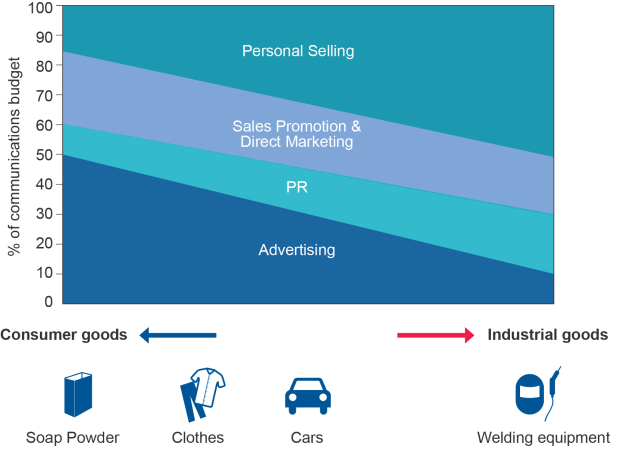
All the while, business-to-business marketers have been sitting on the sidelines. They do not have the huge marketing budgets that are required for global campaigns. In fact, $200,000 is likely to be a respectable budget for many an industrial company or division aiming at an international market. With such meagre funds to play with, their communication efforts have been much more targeted and therefore less visible for us to examine and critique.

With an emphasis on below-the-line advertising, business-to-business marketers have focused on anything that gets them close to shaking hands with a potential customer. High on the list are exhibitions, brochures and technical sheets translated into local languages, and, if you’re lucky, a website on which you may just have one or two language options. There is very little attempt made to understand the local culture and to design a promotional campaign that meets local needs.

If marketing budgets are really so small for business-to-business marketers, it may be hard to imagine how they could afford to spend $100,000 on a market research campaign aimed at testing different communications and finding out what works over a wide geographical area. Mind you, the investment in research to establish the principles of what works pays dividends – not only on the current campaign but on all future campaigns.

I encountered a good example a couple of years ago during the concept testing of an advert. Of the seven adverts being tested, the design agency had a clear favourite – a nicely designed ad showing two futuristic-looking heads. However, in what was a huge disappointment to the agency, this particular ad bombed dramatically when tested against the six others among an international group of target customers. Existing and potential customers actually found the ad confusing and felt it portrayed the company as two-faced. Adverts that tested much better were less stylish but they featured the product, or the product plus a person.

A good test for any b2b marketer is to lay out their promotions in front of customers and prospective customers, and ask the following questions:

  • What are first reactions to the promotions?
  • What are the key things that jump out of the promotions?
  • What are the promotions saying to you?
  • How would you rate the clarity of the message(s)?
  • What are the benefits that are communicated by the promotions?
  • How important are these benefits to you?
  • How effective are the promotions in terms of being compelling (“stop-ability”), relevance, links to the positioning of the advertiser, and clarity?
  • How successful are the promotions in “calling the customer to action”?
  • Do respondents think anything is missing from the promotions?
  • How clear is it what people should do next, having seen the advert (i.e. how effective are the response mechanisms and instructions)?

Market research isn’t the only measure that can be used to test the effectiveness of promotions. Additional indicators can be quite simple, such as:

  • The correlation between the sales of a product and a promotional campaign. However, the long lead times in business-to-business markets seldom show strong links between the two.
  • Response mechanisms built into adverts or literature that over time provide feedback on the effectiveness of campaigns.
  • Orders taken on an exhibition stand (or, more simply, the number of business cards collected on the stand).
  • Feedback to the sales team (and order takers) that a promotion has been seen.

In conclusion, here’s a checklist of questions that business-to-business marketers should consider when addressing global markets:

  1. Start with the views of locals – no one knows or understands the market better and their views are always worth listening to. However, be prepared to experiment and be bold, because the best promotions are those that break the mould.
  2. Promotions are most effective if they have a single, purposeful proposition. Many promotions are overloaded with too many propositions or they are too clever by half.
  3. Promotions that look authoritative, even editorial in style, will be eagerly read by a technical audience.
  4. Technicians love facts. Give them loads of them.
  5. The product may be boring to some people but it isn’t to the person who is buying or specifying it. Show them the product.
  6. Promotions that feature someone from the company are far more believable than those that use actors.
  7. People will give a fraction of a second to a promotion (a blink) as they make up their mind whether it is for them or not. Catch their attention with images and visuals at the top of the ad and use them boldly. Use them to draw people into the promotion.
  8. Make sure that the images are relevant otherwise the audience will quickly move on. The closer the relevance of the images to the industry and the text, the better.
  9. The headline of any promotion needs to be strong and powerful. Many headlines fail by being too long, too complicated or irrelevant. The headline should follow the visual or lead at the top of the ad.
  10. When developing a campaign, give it “legs”. Wherever possible, create a connection with parallel or previous campaigns so that there is a link that provides continuity for the audience.


In the St. Nick of Time

Friday, November 13th, 2009


Post to Twitter Post to Facebook Post to LinkedIn

David Ward this week takes the time to point out that in marketing, just as in many aspects of life, timing is everything.

A disturbing thing happened to me about 2 weeks ago. But before I tell you what that was I wanted to share with you something I read in an edition of New Scientist from the 24th October. The article looked at how the brain perceives time. Have you ever noticed how sometimes particular events in our lives appear to happen at differing speeds? If we are having a bad day where things are going poorly, the day can seem to last an eternity. On a good day it can appear to speed along and, before you know it, the day is over.

In one experiment carried out by David Eagleman at Baylor College of Medicine in Houston, a man was dangled off an eight-story-high tower and dropped. After a drop of several seconds, he landed unharmed into a safety net below. Eagleman wanted to know whether during the drop or extreme events the brain’s clock accelerates, making what’s happening around us appear to happen much more slowly. Other than this experiment, the article also discussed how we perceive what happens around us as series of frames rather than a continuous stream and we collect information through discrete snapshots.

“Time,” as Eagleman puts it “is weirder than we think it is.”

I said at the start of this Thursday Night Insight that something disturbing happened to me about 2 weeks ago. No amount of peculiar perceptions or warping of time could account for it. I am sure I experienced what I did and I refuse to be told otherwise. And what was it that I experienced, I hear you ask? At the end of October, in a coffee shop in Bramhall, I heard the unmistakable sounds of Christmas music coming from the speakers. Yes, that’s right. Christmas music. Even before the celebrations of Bonfire Night were upon us, there it was, Christmas.

Now this isn’t a tale of Bah Humbug on my part. I happen to not mind Christmas one little bit. It has its merits. With presents, time off work, time spent with the family, and a special time religiously for some, what’s not to like? Christmas, however, seems to be rammed down our throats earlier and earlier each year. Unlike the Americans, we Brits don’t have a barrier such as Thanksgiving to provide us with a shield to the festive season starting too soon. Now, 2 weeks after the first disturbing signs of Christmas, the commercials on TV are increasingly becoming Christmas themed. By the time the big day comes around it’s a wonder we’re not all sick of hearing about it. I don’t know, maybe we are!

My message this week is twofold. Firstly, timing in marketing is an important thing. Targeting the right people at the right time with the right message about your brand and your offering is a key element. Too soon before a new product is launched, for example, and people forget. Too late and there’s not enough time to get your message across. Drag it on for too long and its effects can be negative. Secondly, let’s start the run in to Christmas later than October. I for one would love to hear nothing of Christmas until mid November. Let’s try not to warp time by attempting to stretch what is one day of the year into 8 weeks.


Thank Crunchie it’s Friday

Friday, October 23rd, 2009


Post to Twitter Post to Facebook Post to LinkedIn

Caroline Harrison this week takes a look at a current promotional campaign which gives us all another reason to be glad today is Friday.

It’s one of the top challenges for marketers: how do we drive more traffic to our website? There are many different search engine optimisation and search engine marketing tactics we can employ to help us in our quest, but we shouldn’t necessarily forget some of the good old fashioned basics: aside from creating an informative and user-friendly website, we can try to make the site – or a feature/section within it – different and unique, make it engaging or interactive, offer website-only deals and special promotions…basically give people a reason to visit in the first place and to return.

Of course, increased traffic to your website doesn’t automatically translate into increased sales. There is, however, clearly some correlation. More visitors give you more chances to showcase your services and, with it, more opportunities to turn those visitors into brand advocates and loyal customers.

I read in the marketing press recently (further note to marketers: don’t forget to generate a PR buzz around a quirky website feature or promotion) about a ‘freebie’ being offered by Cadbury at its Crunchie chocolate bar website, www.getthatfridayfeeling.com. (Why is it that my Thursday Night Insights always seem to be about Cadbury’s chocolate??) In its latest digital campaign for this brand, Cadbury is, for a limited time, giving away a free Crunchie to the first 500 visitors to register on the site each Friday.

Now, for those international readers of this blog who aren’t so familiar with a Crunchie, the brand has been associated with a ‘Friday Feeling’ advertising concept, encapsulated by the well-known strapline ‘Thank Crunchie, it’s Friday!’, since the mid 1980s.

I remember when Cadbury first introduced this strapline. Somehow it just struck a chord – certainly with my peers in the school playground, many of whom, in retrospect, would have been avid guzzlers of this chocolate bar and among Cadbury’s prime target markets.

Even today, many years on from the start of the campaign, I regularly see ‘Facebook friends’ – all now in their 30s – update their ‘status’ at the end of the working week with those immortal words ‘Thank Crunchie it’s Friday!’. Friday is, after all, the day to treat yourself…What the heck, it’s nearly the weekend – I’ll have fish and chips for lunch, a Chinese takeaway for dinner, let’s open another bottle of wine, give me that chocolate bar…

So, do sales of Crunchie rise significantly on a Friday? Does a sizable proportion of the UK’s population effectively promote the brand by word of mouth one day a week? If so, I guess you could call it a pretty successful campaign. But, let’s face it; Cadbury won’t want sales to suffer the other six days out of every seven. By encouraging us all to ‘Get That Friday Feeling Every Day’, Cadbury is trying to associate its brand with feeling good, enjoying life, treating ourselves. Why should we only feel happy as we’re leaving work or finishing school on a Friday? Life’s too short to be miserable the rest of the week!

This latest campaign centred around getthatfridayfeeling.com might not be groundbreaking as such, but it’s still pretty inventive and a clever way to encourage people to go to the site. Giving away 500 Crunchies a week for 6 weeks won’t exactly break the bank for Cadbury, but there are bound to be far more than 500 website visitors trying to get their hands on a free chocolate bar. Why, with 500 available every Friday, it certainly seems within the realms of possibility that you or I could be munching away on a free Crunchie soon. Even if you’re not one of the lucky ones, it’s still brought the brand to front of mind. If you haven’t had a Crunchie for some time, it could just whet your appetite for one. Next time you’re in the chocolate aisle at the supermarket, Crunchie might just get the nod ahead of your usual preferred snack.

This wasn’t my planned Thursday Night Insight for this week, but seeing as the promotion finishes next Friday (30 October), I thought you might appreciate the tip. I’m afraid this offer is only available to UK residents, but I’ll keep my eyes peeled for any tasty global freebies.


May The Force Be With You

Friday, July 31st, 2009


Post to Twitter Post to Facebook Post to LinkedIn

In her first Thursday Night Insight contribution, Research Executive Afshan Bhatti sheds some light on becoming a Jedi Master of Social Influence and how an understanding of six basic psychological principles can greatly benefit us in becoming better persuaders both in our working and personal lives.

As I sit here reluctantly watching Stars Wars for the second time today with my nephew, my mind starts to wander – Luke Skywalker gained the ultimate form of compliance: he persuaded Darth Vader to turn against the evil emperor, saving his own life in the process as well as restoring hope and peace to the galaxy. Okay so we’re not trying to save the world, but surely the principles of persuasion are the same even if in this case it was in a galaxy far, far away. So, I found myself asking just what are these weapons of influence and how can they be used to help our attempts to be a major force in our industry?

Stop and think for a moment – how many times during the past day has someone tried to change your mind? The answer may well be a surprise as it’s quite clear that each day we are bombarded with numerous efforts of this type. Radio and television adverts, newspapers and magazine ads, people on the phone or knocking at your door… The list is endless. Persuasion, it would seem, is at the very core of any marketing strategy and an understanding of the psychology behind it not only gives us a fascinating insight into people but also helps us to develop marketing strategies to effectively reach the consumer.

One of the most potent weapons of influence is Reciprocation. Put simply, if someone does something for us, we feel obligated to return the favour. I mean ladies, how many times have you been approached by the always-smiling, friendly makeup girl and, before you know it, you’re sitting in the chair being shown the latest makeup trends and treated to “free” samples. “Why not?” I hear you say. True, but before long, you find yourself tangled in the natural indebting force inherent in a “free makeup lesson” and somehow, yet again, you’re walking away with another high-gloss smudge-proof 24-hour power lipstick you just didn’t need. As a marketing technique this is very effective as even someone like me, who is very aware of the “non-existence” façade claiming the intention to inform, falls for it hook, line and sinker!

Another effective strategy is Scarcity, which implicitly tells us “what is scarce is good.” It’s a basic human desire to want what we can’t have, and the feeling of missing out on something apparently “this good” influences us to take action. I mean we only have to turn on the television and there we have it, advertisers informing us that their products are available for a “limited time only” or “sale ends tomorrow”. This technique is very effective for getting procrastinators to take action immediately or risk missing out. A prime example was on a recent shopping trip. I saw a dress I liked but, since I’d purchased two already, I was in two minds about purchasing a third. So I thought to myself “I can always come back another time”, but then I found out it was the only one left in the store, and yes, you guessed right – I just had to have it. The possibility of losing something was too much to bear (yes even a dress can elicit this feeling!) and is more of a powerful motivator than it is gaining something.

The tendency to see an action as more appropriate when others are doing it is referred to as Social Proof. This feeling of security is something that marketers want to elicit in the consumer as it will increase their chances of purchasing products or using services. If others are doing it, then it must be the right thing to do. This principle of influence kicks in even more strongly when the situation is uncertain or people aren’t sure what to do. When you can show them what others like themselves believe or are doing, people are more likely to take the same action. Savvy marketers make use of positive experiences of satisfied customers (aka testimonials) to induce prospects to buy their products or use their services. Sometimes it pays to brag about your accomplishments and popularity!

Liking as the next principle should be no surprise. I mean we are more likely to say yes and be persuaded by those we like and trust. Build relationships with your clients, be transparent, use various outlets to show people who you are and connect with your audience. The more you put yourself out there, the more people will like you. The more people like you, the more influence you’ll have. It’s as simple as that.

We, as humans, are programmed to listen and respond to an Authority figure and place great trust in them. We are more likely to be influenced by someone of this status than anyone else. Take, for example, this month’s In Style magazine. The adverts always have the latest revolution in haircare products endorsed by famous celebrities (who, of course, have the glossiest, shiniest hair known to man) accompanied by a testimonial from a leading hairdresser to the stars. Now I, for one, perceive these as experts in haircare, hanging on to their every word – which ends up burning another hole in my pocket as I find myself purchasing not 1 but all 5 miracle hair products that work in sync with each other and “must” be utilised together to get salon type results.

Finally the last principle is Commitment And Consistency. That is, people are more likely to go along with something if they perceive it as aligned with commitments they have already made. This drive to be consistent constitutes a highly potent weapon of social influence. Socially and culturally, it’s important that we are viewed as people who stick to their word, who make consistent choices and who can be understood on the basis of past actions. Inconsistent people can be seen as difficult, flaky, unreliable and undesirable. Clearly, in any society, consistency is a valuable trait, and the need to appear consistent, especially in business, is paramount.

The six principles act as the foundation for the majority of successful social influence strategies. Our ability to persuade others to our way of thinking is one of the most important and indispensable skills that we must learn and master. With it, we can climb the corporate ladder, win new clients, advance our business forward, and convince our partner to our way of thinking :) . Conversely, without it, we are merely lost souls at the mercy of external forces that control our every decision and action.

Finally, if I haven’t succeeded in persuading you, consider the words of Donald Trump "Study the art of persuasion, practice it and develop an understanding of its profound value across all aspects of life." If it’s good enough for Donald then it’s good enough for me!!!


« Previous Entries Next Entries »