

When clients come to us for research amongst their customers and potential customers, we find it helpful to know what makes them special. We ask them to tell us about their company’s unique selling point and their core competences – the central, driving forces of their business. This is far harder than it seems and many struggle.
What Makes You Special?
A company’s core competences are the engines of its success and are in constant need of recognition, development and consolidation. Of course this is only possible to maximum effect if the company has a clear understanding and appreciation of what they are.
A company’s core competences can be defined as:
The activities for which resources are deployed in such a way that they achieve a differential and sustainable competitive advantage in the marketplace.
They are more valuable if they are unique, difficult for competitors to imitate, and are associated with the company’s unique selling point(s) and customer value proposition. The core competences may be direct activities such as product design (e.g. the Dyson vacuum) or customer service (e.g. John Lewis staff), or they may be indirect (e.g. trust in the Shell brand). Whether direct or indirect, the activities are usually broad in scale and scope, thereby maximising return.
Michael Porter argues that there are distinct competences that are crucial to a business’ success. He suggests that companies can use these core competences to position themselves as differentiated, low-cost or playing within a niche. Determining where a company stands in terms of these competences is critical as the worst place to be is caught in the middle where you are neither one thing nor the other. A mistake that many companies make is to fail to recognize their position within a market and align it with their core competences. As a result, the most important distinguishing benefits of their offer are inadequately communicated and they are forced to compete mainly on price. The result is an inevitable drift towards selling commodity products with little or no margins.
Three Steps To Identifying Core Competences
Identifying core competences is not easy. If someone ask you “What makes you special?” you may come up with a quick answer, but the more you think about it, the more you will struggle. If you answer “because I am committed”, you may then realise that you are not sure what makes you committed. Without understanding the answers behind the answers, we cannot really understand our core competences. It may be helpful to think of this questioning in three steps:
- Identify what your customers would consider to be the key reasons for success, i.e. the perceived value of your company’s offerings. It would be useful to consider:
- How necessary the competence is to customers
- How difficult the competence is to imitate
- How broad the competence is
- Identify why your company is successful, based on the primary reasons for success acknowledged in step one. This will provide an understanding of the measures required to achieve success.
- Identify how the attributes given in step two are linked. This is important in recognising how core competences are part of your company as a whole, and how certain activities have an impact on a variety of processes.
Activity Mapping
The last step is important in order to sort out the core competences – the ones that really matter. It is helpful to see how they ‘network’ with each other, some supporting others to the point that you can see which are the most important for you in your business. Returning to Michael Porter, he recommends we can do this by creating an activity-system map, in which clusters of activities and processes which support the core competences are linked. This is illustrated below in an activity-system map for Ikea.
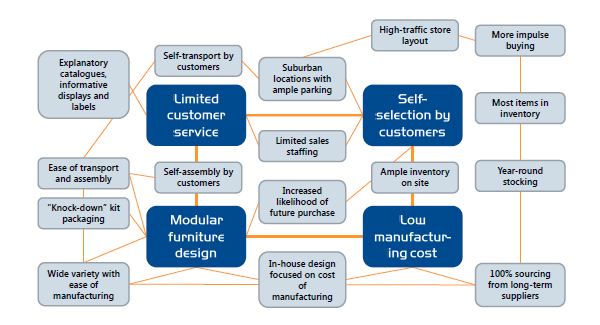
Such a map makes it clear how a company’s activities are interlinked. For example, one of Ikea’s core competences is its self selection by customers. The activities that directly contribute to this core competence are the suburban locations with ample parking, most items in inventory, ample inventory on site, limited sales staffing, limited customer service, and increased likelihood of future purchase. A failure of any of these activities may have an effect on the core competence, and therefore on the company’s overall success and competitive position.
How Market Research Can Help
Once you have identified your company’s core competences and contributory activities of the kind seen in the Ikea activity-system map, you may consider market research to help your company align these to the needs of the market. Core competences are the internal capabilities of your company and they may or may not be valued by the outside world. The role of market research is, therefore, to find out what is valued and what is not. Inevitably there will be groups of customers whose needs have a closer affinity to the competences of your company and these will be a key segment for targeting. However, there may be groups of customers who like your competences to a different degree from those who are your key target market.
In the case of Ikea, for example, it may be that the principal segment are customers who like the convenience of being able to drive to a store, park, make their choice and drive away with their furniture. However, there may be others who do not value these competences but who like the simple Scandinavian designs sold by the store. They may not want to drive out to the store and therefore eschew the core competence of the self selection at the store. Market research can be used to map out customers’ and potential customers’ needs so that they can be compared and aligned with the supplier’s core competences. The second group of customers could potentially be satisfied by an online offer or a telephone service which helps them make their choice.
In other words, core competences are dynamic and can be built and adjusted to suit the needs of the market. The art of profitable businesses is to match resources (core competences as we describe them in this paper) with the needs of the market.
In summary, the process we suggest is similar to that which anyone would use when crossing the road:
- STOP – Identify your core competences and the activities that surround these.
- LOOK – Closely look at your competences and activities to determine how you can strengthen them. Consider the perceived value of your company’s offerings and identify to what extent your company is successful using the core competences.
- LISTEN – Listen to your customers to obtain their feedback on your offerings (and those of your competitors) and to assist you in strengthening your competences and activities further. Link these needs back to your core competences and find differentiating features in your offers (customer value propositions) that will be attractive to customers in your target segments. Using the value proposition canvas framework can be a useful way of organizing this task.